GST Invoice Format: Rule 46 Fields & Free Excel Template
By Farasat Abbas Naqvi · Published June 20, 2026 · Updated July 24, 2026
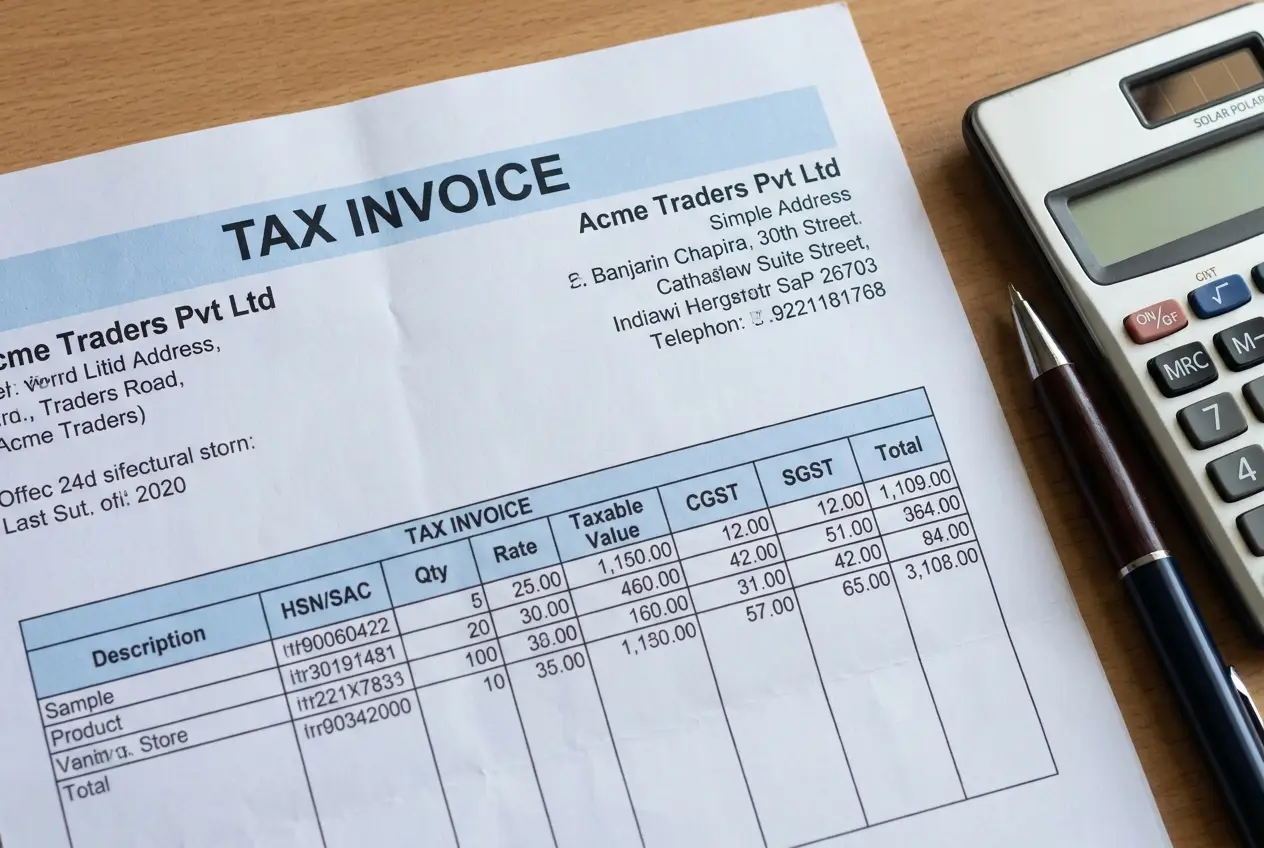
A GST invoice format is the standardised layout of a tax invoice that captures every particular Rule 46 of the CGST Rules, 2017 demands from a GST-registered supplier — GSTIN, HSN or SAC codes, taxable value, the CGST/SGST/IGST split, place of supply, and roughly a dozen more. Miss one field and the pain usually lands on your buyer: their input tax credit (ITC) depends on your invoice being complete and reported in your GSTR-1.
Below: every mandatory field in one table, a bill worked through in ₹, the CGST + SGST versus IGST rules, HSN digits, the 16-character invoice number limit, 2026 e-invoicing (IRN and QR code) thresholds, and free Excel, Word, and PDF downloads. Naming note: a gst bill format and a GST invoice format are the same document — the law says tax invoice, the shop counter says bill.
In a hurry? The free GST invoice format generator fills every Rule 46 field and exports all three file types, or you can create a GST invoice online free without signing up.
What Is the GST Invoice Format?
The GST invoice format is the set of particulars Section 31 of the CGST Act, 2017 and Rule 46 of the CGST Rules make compulsory on every tax invoice: supplier and recipient details with GSTINs, a serial number up to 16 characters, the date, HSN or SAC codes, description, quantity, taxable value after discount, tax rate and amount per head, place of supply, a reverse-charge declaration where due, and a signature. The legal text sits in the CGST Rules, 2017 on cbic-gst.gov.in.
There is no prescribed template — layout is yours, only the particulars are fixed, so a legible handwritten bill is as valid as a designed one. The document also fixes the time of supply, feeds GSTR-1, validates the e-way bill, and under Section 16(2)(aa) decides whether it reaches your buyer's GSTR-2B for ITC; in audits it is primary evidence, and exporters lean on it for LUT refunds.
Every registered business — manufacturer, trader, retailer, freelancer, e-commerce seller — must issue one per taxable supply; below the registration threshold an ordinary invoice does, and a proforma invoice — a pre-sale quotation — is not a GST document at all. Formally this is the gst tax invoice format; informally, the bill your customer expects.
Mandatory Fields Under Rule 46: The Complete Table
Here is Rule 46 as a checklist to hold an invoice against.
| # | Field | What Rule 46 requires |
|---|---|---|
| 1 | Supplier details | Legal name, address, and 15-digit GSTIN as on the registration certificate |
| 2 | Invoice number | Consecutive serial number, max 16 characters, unique within the financial year |
| 3 | Date of issue | Day the invoice is raised (DD/MM/YYYY is the convention) |
| 4 | Recipient details | Name and address; GSTIN mandatory for registered (B2B) buyers |
| 5 | Unregistered buyer, ₹50,000+ | Name, address, delivery address, state name and code become compulsory |
| 6 | HSN / SAC code | HSN for goods, SAC for services — digits depend on turnover (below) |
| 7 | Description | Clear, specific wording — "miscellaneous goods" invites disputes |
| 8 | Quantity and unit | For goods, with a Unit Quantity Code (UQC): PCS, KGS, LTR, MTR, NOS, BOX |
| 9 | Total value | Gross value of the supply |
| 10 | Taxable value | Value after discount — Section 15 lets on-invoice discounts reduce it |
| 11 | Tax rate | CGST, SGST/UTGST, IGST and cess percentages shown separately |
| 12 | Tax amount | Rupee amount of each tax head, not one merged figure |
| 13 | Place of supply | State name and code — decides the tax on inter-state supplies |
| 14 | Delivery address | Shipping address where it differs from the billing address |
| 15 | Reverse charge note | "Tax is payable on reverse charge basis" where Section 9(3)/9(4) applies |
| 16 | Signature | Physical or digital signature (DSC per the IT Act, 2000) of the supplier or authorised signatory |
Export invoices add the declaration "SUPPLY MEANT FOR EXPORT ON PAYMENT OF IGST" (or "UNDER BOND OR LETTER OF UNDERTAKING WITHOUT PAYMENT OF IGST"), the destination country, and shipping bill details. Inter-state B2C invoices of ₹1 lakh or more (since 1 August 2024) must state the delivery state code for invoice-wise GSTR-1 reporting. One missing field makes the invoice legally deficient — a Section 122 penalty risk.
GST Invoice Number Rules: 16 Characters, Not 16 Digits
Is there a 16-digit GST invoice number format?
No — the rule is a 16-character maximum, and none of those characters has to be a digit. Rule 46(b) requires a consecutive serial number, unique within a financial year, built from letters A–Z, numerals 0–9, and the hyphen or slash. "16-digit format" is a misreading of that limit; a number can be 1 to 16 characters long.
Patterns like INV/25-26/0142 keep the financial year visible. Each branch may run its own series — two offices can both start at 0001 — as long as nothing repeats within a series; duplicates fail on GSTR-1 upload. Changing the pattern mid-year? Intimate your GST officer in writing.
CGST + SGST or IGST: Getting the Split Right
Charge CGST + SGST when the place of supply and your registration are in the same state, each at half the headline rate — an 18% item bills as 9% + 9%, a 5% item as 2.5% + 2.5%. Charge IGST at the full rate when the states differ, and on imports, exports, and SEZ supplies. In union territories, UTGST replaces SGST. Never both on one line: the IGST column stays blank on an intra-state invoice, and vice versa.
A note from years of reading small-business bills: the expensive mistake is rarely arithmetic — spreadsheets get 9% of ₹80,000 right. It is picking the wrong head. Charge CGST + SGST where IGST was due and Section 77 makes you pay the correct tax in full, then claim the wrong one back — months of tied-up working capital.
GST Bill Sample With Real Numbers
A worked gst bill sample makes the split concrete. A Jaipur furniture dealer sells 20 swivel office chairs (HSN 9401) at a ₹4,200 list price with a ₹200 per-chair discount on the invoice — rate ₹4,000, taxable value ₹80,000, GST 18%. Invoice PI/25-26/0087, reverse charge: No.
| Line | Intra-state (buyer in Rajasthan, code 08) | Inter-state (buyer in Gujarat, code 24) |
|---|---|---|
| Taxable value (20 × ₹4,000) | ₹80,000 | ₹80,000 |
| CGST @ 9% | ₹7,200 | — |
| SGST @ 9% | ₹7,200 | — |
| IGST @ 18% | — | ₹14,400 |
| Invoice total | ₹94,400 | ₹94,400 |
The grand total also appears in words — "Rupees ninety-four thousand four hundred only" — alongside bank details, terms and conditions, and the authorised signatory.
HSN and SAC Codes: How Many Digits Do You Need?
Since 1 April 2021, CBIC requires 4-digit HSN codes on B2B invoices when aggregate annual turnover (AATO) is up to ₹5 crore, 6-digit codes on all invoices above ₹5 crore, and 8-digit codes on exports and notified goods. Under ₹5 crore, HSN stays optional on B2C bills — though printing it saves arguments later.
| Aggregate annual turnover | HSN digits | Example (office chairs) |
|---|---|---|
| Up to ₹5 crore | 4 digits on B2B (optional on B2C) | 9401 |
| Above ₹5 crore | 6 digits on every invoice | 940130 |
| Exports / notified goods | 8 digits | Full tariff code |
Services use SAC codes instead — six digits beginning with 99, such as 998313 for web development or 998221 for accounting — and skip the quantity/UQC column, since "20 hours" is description, not a unit of goods.
Tax Invoice vs Bill of Supply
A tax invoice charges GST and lets a registered buyer claim ITC; a bill of supply shows no tax and supports no credit. It is issued in two cases: by composition scheme dealers, and for exempt or nil-rated supplies. Composition dealers must print "composition taxable person, not eligible to collect tax on supplies" — so if you have been hunting for a composition GST invoice format PDF, what you actually need is a bill of supply.
A bill of supply still carries HSN/SAC codes and most other particulars — only the tax columns go; ITC, subject to Section 16, travels with tax invoices alone. Selling taxable and exempt items to one unregistered customer? Notification 45/2017 permits a single invoice-cum-bill of supply.
Other GST Billing Documents You May Need
- Aggregate invoice — daily consolidation of supplies under ₹200 to unregistered buyers (₹80 + ₹90 + ₹120 = one ₹290 bill).
- Receipt voucher — for advances received before supply; a refunded advance gets a refund voucher instead.
- Self-invoice — under reverse charge (Section 9(3)/9(4)), the recipient raises the invoice plus a payment voucher.
- Revised invoice — for sales made while registration was pending; reissue within one month of the certificate as "Revised Tax Invoice".
- Debit and credit notes — Section 34 corrections; credit notes must be declared by 30 November after the financial year, debit notes any time — see our credit note vs refund guide.
- Delivery challan — moves goods without a sale (job work, liquid gas, goods on approval, exhibitions); see the delivery challan format.
- Export and SEZ invoices — may use foreign currency, with the INR value at the RBI reference rate.
Banks, insurers, and NBFCs may bill monthly within a 45-day window; a passenger transport ticket is itself the tax invoice; goods transport agencies and input service distributors have special formats.
E-Invoicing in 2026: Who Needs an IRN and QR Code
If your AATO has crossed ₹5 crore in any financial year since 2017-18, every B2B invoice, credit note, and debit note must go to the Invoice Registration Portal (IRP), which returns a 64-character Invoice Reference Number (IRN) and a signed QR code — both must print on the invoice. The threshold stepped down from ₹500 crore (October 2020) through ₹100, ₹50, ₹20, and ₹10 crore to ₹5 crore on 1 August 2023, where it stays for FY 2026-27; details on the government's e-invoice portal.
E-invoicing is not billing on a government website: you invoice in your own software, send the JSON to the IRP, and print the IRN and QR on your usual layout — a GST e-invoice format PDF is just your regular invoice plus those two elements. Since 1 April 2025, taxpayers above ₹10 crore AATO must report documents within 30 days or the IRP rejects them; an IRN is cancellable for 24 hours, after which only a credit note reverses it. B2C invoices sit outside the system, while banks, insurers, NBFCs, goods transport agencies, passenger transport, multiplex cinemas, SEZ units, and government departments are exempt even above the threshold. A B2B invoice missing a required IRN counts as no invoice: ₹10,000 per document, buyer's ITC denied. Our e-invoicing guide covers IRP registration.
How to Write a GST Invoice (Step by Step)
To write a GST invoice, put your business name, address, and GSTIN at the top, assign the next serial number and date, add the buyer's details and place of supply, list each item with HSN or SAC code, quantity, rate, and taxable value, apply CGST + SGST or IGST based on the states involved, write the total in figures and words, and sign.
- Enter your legal name, address, GSTIN, and logo.
- Assign a consecutive invoice number (16 characters or fewer) and the date.
- Add the recipient's name, address, and GSTIN (mandatory for B2B).
- State the place of supply with state code.
- List items: description, HSN/SAC, quantity with UQC, rate, discount, taxable value.
- Show each tax head's rate and amount separately.
- Add the reverse-charge note if applicable, then the total in figures and words.
- Sign physically or digitally (DSC) and share the PDF by email or WhatsApp.
Timing: goods — on or before removal or delivery; services — within 30 days of supply (45 for banks and financial institutions); goods on approval — within six months.
How to make a GST invoice bill in Excel
Making a GST invoice bill in Excel takes four formulas: taxable value as quantity × rate minus discount, CGST and SGST as half the GST rate each (or one IGST cell at the full rate), and a SUM for the grand total — wrap each in ROUND so paise never drift. The sheet doubles as a GST invoice calculator: change a quantity and every tax figure updates. Our gst invoice format in excel ships with these formulas prebuilt — and a spreadsheet, or even a printed bill book, is fully compliant if every Rule 46 field is present.
Download the GST Invoice Format in Excel, Word, or PDF
Download the GST invoice format free — no sign-up, no watermark. All three files carry the full Rule 46 field set with CGST/SGST/IGST columns ready.
| Format | Best for | Download |
|---|---|---|
| Excel (.xlsx) | Traders and retailers with many line items — auto-calculation built in | GST invoice format Excel sheet |
| Word (.docx) | Service providers who want branding and clean layouts | GST bill format in Word |
| Printing and sharing — tamper-proof, layout preserved everywhere | GST bill format PDF |
The gst bill format in excel suits volume billing — formulas compute the split, so a 30-line invoice takes minutes. The Word file is the consultant's pick: swap the HSN column for SAC, add letterhead and bank details. The PDF is what you actually send; it survives WhatsApp and email intact. Billing occasionally? A simple gst bill format with one item row and two tax columns beats a cluttered template. For anything bigger, the GST invoice format generator exports Excel, Word, and PDF from one page.
How Many Copies of a GST Invoice Are Required?
Three copies for goods — the original GST bill marked "Original for Recipient", a duplicate for the transporter, and a triplicate for the supplier's records — and two for services, where only the recipient's original and the supplier's duplicate are needed. A traditional printed gst bill book format handles this with carbon leaves, one reason bill books survive in trades that invoice at the doorstep.
Common GST Invoice Mistakes (and What They Cost)
- Wrong GSTIN. One transposed character and the invoice never reaches the buyer's GSTR-2B. Before claiming ITC on any purchase bill with GST, check the supplier's GSTIN online via Search Taxpayer on gst.gov.in.
- Duplicate invoice numbers. Repeats within a financial year fail on GSTR-1 upload.
- Wrong place of supply. The wrong tax head follows — the Section 77 pay-again-and-refund loop.
- Missing reverse-charge declaration. RCM supplies without the printed note draw penalties even when the tax itself was right.
- Late invoicing. Shifts the time of supply into the wrong return period; interest runs at 18% per annum under Section 50.
- Unsigned invoices. No signature — physical or DSC — means no valid tax invoice.
- Invoice–return mismatch. Different figures in GSTR-1 than on paper earn your buyer an ITC mismatch notice.
- Missing IRN. Above ₹5 crore, a B2B invoice without an IRN is invalid. Penalties overall: ₹10,000 or the tax involved under Section 122; up to ₹25,000 under Section 125.
This article is informational only, not tax or legal advice — confirm specifics with a chartered accountant. Rule 46 requirements and e-invoicing thresholds were last verified in July 2026 against the CGST Rules, 2017 on cbic-gst.gov.in and the GST e-invoice portal.
Frequently Asked Questions
What is the GST invoice format?
The GST invoice format is the list of particulars Rule 46 of the CGST Rules, 2017 makes mandatory on every tax invoice: supplier and buyer names, addresses and GSTINs, a serial number up to 16 characters, date, HSN or SAC codes, description, quantity, taxable value, CGST/SGST or IGST rates and amounts, place of supply, a reverse-charge note where applicable, and a signature. No layout is prescribed — Excel, Word, PDF, or a handwritten bill all work if every field is present.
How do I make a GST invoice bill in Excel?
Open a blank sheet or a ready GST template and enter your business details and GSTIN, a consecutive invoice number, the date, and the buyer's details. List items with HSN or SAC codes, quantity, and rate, then compute taxable value as quantity times rate minus discount. Add CGST and SGST at half the GST rate each for same-state sales, or IGST at the full rate for inter-state, and total everything. Export to PDF before sending so the layout stays fixed.
Is there a 16-digit GST invoice number format?
No. Rule 46(b) sets a 16-character maximum, not a 16-digit requirement. An invoice number can be any length up to 16 characters and may mix letters, numbers, hyphens, and slashes — INV/25-26/0142, for example. It must run consecutively and stay unique within the financial year; duplicate numbers are rejected when your GSTR-1 is filed.
Is HSN code mandatory on a GST invoice?
Yes, with turnover-based digits. Businesses with aggregate annual turnover up to ₹5 crore must print 4-digit HSN codes on B2B invoices (optional on B2C); above ₹5 crore, 6-digit codes are required on every invoice; exports and notified goods need 8 digits. Services use 6-digit SAC codes beginning with 99 instead of HSN.
What is the difference between a GST tax invoice and a bill of supply?
A tax invoice charges GST and lets a registered buyer claim input tax credit. A bill of supply shows no tax and gives no credit — it is issued by composition scheme dealers, who must print 'composition taxable person, not eligible to collect tax on supplies', and for exempt or nil-rated goods and services.
Who must generate e-invoices with an IRN and QR code in 2026?
Businesses whose aggregate turnover crossed ₹5 crore in any financial year since 2017-18 — a threshold unchanged since August 2023. Every B2B invoice, credit note, and debit note is reported to the Invoice Registration Portal, which returns a 64-character IRN and a signed QR code that must print on the invoice. Taxpayers above ₹10 crore must report within 30 days; banks, NBFCs, transport operators, and SEZ units are exempt.