Difference Between Invoice and Quotation (Free Generator)
By Farasat Abbas Naqvi · Updated July 24, 2026
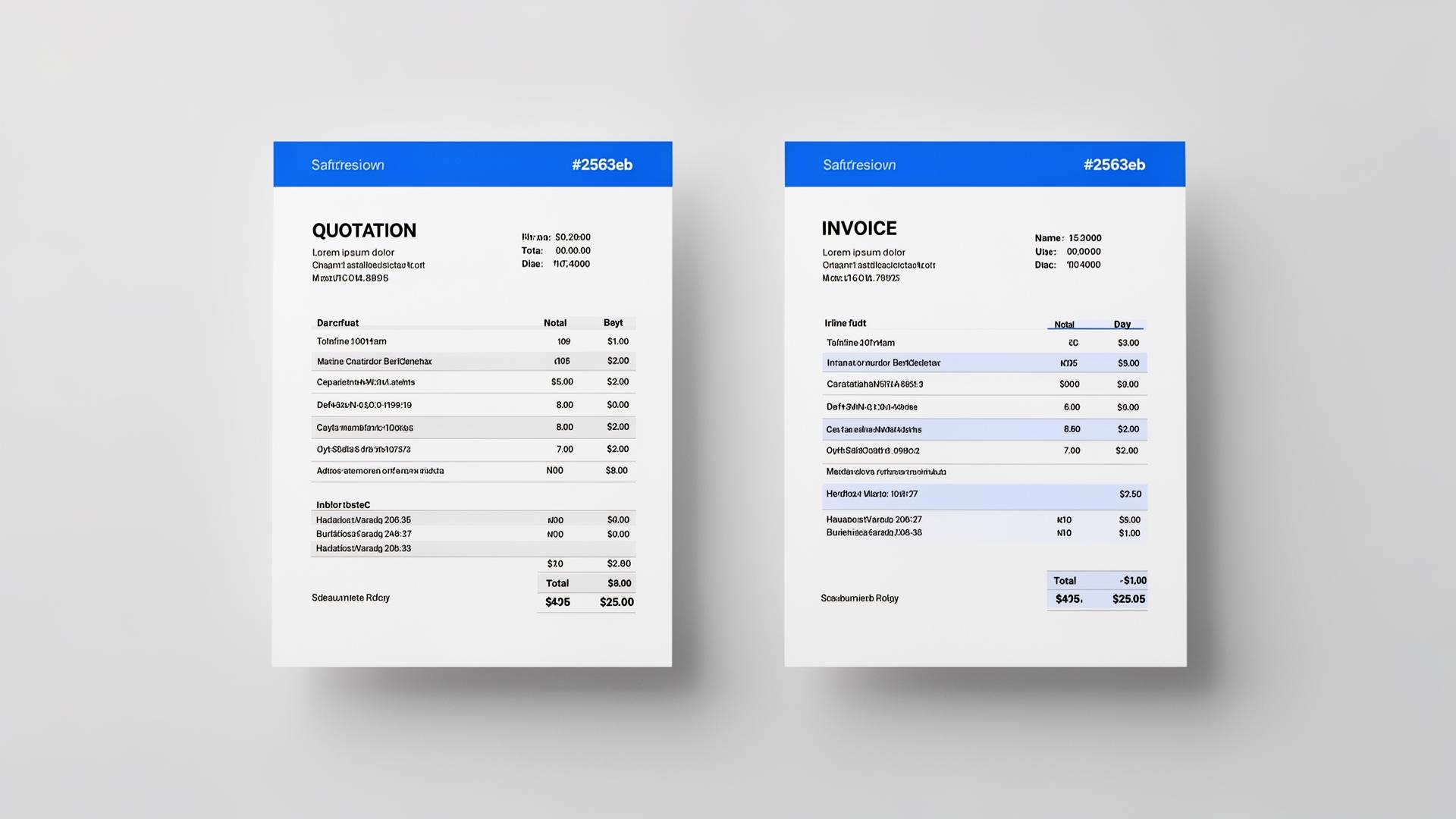
The difference between invoice and quotation is timing and intent: a quotation proposes a price before any work begins, while an invoice requests payment after the goods or services have been delivered. A quotation is a pre-sale offer document that tells a prospective buyer what a job will cost and how long that price holds; an invoice is a post-sale billing document that tells the buyer what they now owe and by when. Mix them up and you look unprofessional at best, create a bookkeeping mess at worst.
Quick Definitions
Invoice vs quotation meaning, the difference between an invoice and a quotation, the invoice and quote difference — every phrasing asks the same thing ("quote" is simply the shorter word). Both documents come from the seller; they sit at opposite ends of the deal.
- Quotation — a price offer issued before work starts. It says "if you accept, this is what it will cost," and it carries a validity period (7–30 days is typical) instead of a due date.
- Invoice — a payment request issued after work is delivered, billed in full, in installments, or per agreed milestone. It says "you now owe this amount, due by this date," and it enters your books as a receivable the day you issue it.
What is a quotation?
A quotation (also called a quote, sales quote, or price quote) is a formal proposal that fixes the price, scope, and timeline of a job for a stated validity period — "valid for 15 days" is the common convention. A complete quotation lists line items with quantities and unit pricing, indicative taxes, delivery timeline, payment terms, exclusions, and an expiration date. Once the client accepts within that window, the quoted price generally cannot change without a fresh agreement. Field by field: our quotation format guide.
What is an invoice?
An invoice is an itemized, timestamped demand for payment covering goods delivered or services rendered. Wherever you trade, it carries a unique invoice number, issue date, supply date, seller and buyer details, a description of what was supplied, taxes, the total amount due, the due date, and accepted payment methods. It doubles as the legal record for taxation and accounting — the document revenue and disputes get traced back to.
What is quotation invoice?
"Quotation invoice" is not an official document — the phrase usually means either a quotation destined to become an invoice, or software that produces both from one item list. To define quotation in invoice terms: the quotation is the priced offer that, once accepted, supplies every line item the eventual invoice will bill. So is quotation same as invoice? No — one offers, the other bills.
Quotation vs Invoice: Side-by-Side Comparison
The whole invoice and quotation difference in ten rows:
| Aspect | Quotation | Invoice |
|---|---|---|
| Purpose | Offer a price and win the job | Request payment for delivered work |
| Who issues it | Seller (supplier) | Seller (supplier) |
| When sent | Before work begins | After delivery, or per milestone |
| Legal status | Commercial offer — not a tax document | Legal payment demand; mandatory accounting record |
| Becomes binding when | The client accepts it within the validity period | On issue, for work already delivered |
| Flexibility | Negotiable — adjust freely until accepted | Final; changed only to correct errors |
| Numbering | Own series — QT- or QUO- prefix | Separate consecutive series — INV- prefix |
| Date that matters | Validity or expiry date (e.g., 15 days) | Payment due date (e.g., Net 14) |
| Typical fields | Scope, validity, terms, exclusions | Taxes, payment instructions, due date |
| Accounting impact | None until accepted | Booked as accounts receivable on issue |
The Quotation → Purchase Order → Invoice Workflow
Most deals follow the same quotation then invoice process — and it makes the difference between purchase order invoice and quotation obvious: quotations and invoices come from the seller, while the purchase order is the buyer's document.
- Inquiry — the buyer asks for pricing, sometimes as a formal request for quotation (RFQ) or tender.
- Quotation — the seller sends a priced offer with a validity period.
- Acceptance — the buyer confirms by email, signature, or by raising a purchase order that references the quote number.
- Proforma invoice (optional) — the seller issues a preliminary invoice-style document for advances, customs, or letters of credit.
- Delivery — the goods ship or the service is completed.
- Invoice — the seller bills the agreed amount, referencing the quote and PO numbers.
- Payment and receipt — the buyer pays by the due date; a receipt confirms the payment.
The pattern scales down, too: a freelancer or wedding photographer quotes before the shoot and invoices after completion, while contractors split multi-phase jobs into per-phase quotes and interim invoices. Buyer-side paperwork in detail: invoice vs purchase order vs quotation.
Worked Example: One Job as a Quote, Then an Invoice
Nothing shows the difference between invoice and quotation with examples better than the same transaction in both formats. Take Acme Studio's $2,400 logo redesign:
Day 1: Acme Studio sends Quote QT-2026-0044 for a logo redesign at $2,400, valid 14 days.
Day 5: The client accepts, signs the quote, and raises purchase order PO-8841.
Day 6: Acme issues Invoice INV-2026-0218 for the 50% deposit ($1,200), Net 7.
Day 30: Final delivery — Acme issues Invoice INV-2026-0242 for the remaining $1,200.
| Field | Quotation QT-2026-0044 (Day 1) | Invoice INV-2026-0242 (Day 30) |
|---|---|---|
| Document label | "Quotation" | "Invoice" |
| Line item | Logo redesign — $2,400 | Logo redesign, final balance — $1,200 |
| Key date | Valid until Day 15 | Due Day 37 (Net 7) |
| References | None | Quote QT-2026-0044, PO-8841, deposit invoice INV-2026-0218 |
| Tax | Shown as indicative | Charged at the actual rate |
| In the books | Nowhere | Accounts receivable, Day 30 |
Same job, same client, same $2,400 — entirely different paperwork.
Is a Quotation Legally Binding?
A quotation is not binding when you send it — it is an offer — but it generally becomes binding once the client accepts it within the validity period, at which point it works like a contract on price and scope. An estimate, by contrast, is a non-binding ballpark for variable-cost work; a written, accepted quote commits you to the number, so only quote figures you are certain you can deliver. Expired or rejected quotations bind nobody, and a quotation is never a tax document — acceptance creates a commercial commitment, not a GST or accounting entry.
Can a Quotation Number Be the Same as an Invoice Number?
Technically yes — no law forbids Quote 1042 and Invoice 1042 carrying the same number — but you should run two separate series anyway. In India, Rule 46 of the CGST Rules 2017 requires every tax invoice to carry a consecutive serial number unique within the financial year, and mixing quotes into that sequence breaks exactly that. People who search "can quotation number be invoice number" are usually trying to connect the two documents; do it with a reference line ("Ref: Quote QT-1042") rather than shared numbering.
The failure mode we actually see is not confused prefixes — it is sellers running one number sequence for everything. Every quote that never converts leaves a gap in the invoice series, and gap-free numbering is precisely what auditors and GST officers look for. Prefix quotes QT-, invoices INV-, and let the two series run independently.
Difference Between Tax Invoice and Quotation (India GST)
Under GST, the difference between tax invoice and quotation is legal, not cosmetic: a tax invoice records an actual supply, creates the supplier's tax liability, and lets a registered buyer claim input tax credit (ITC), while a quotation is a commercial offer with no GST standing at all.
| Point | Quotation | Tax invoice |
|---|---|---|
| GSTIN required | No | Yes, for registered suppliers |
| Format | Free format — best practice is printing "This is a quotation, not a tax invoice" | Mandatory fields under Rule 46 of the CGST Rules 2017, including HSN/SAC codes |
| Tax shown | Indicative ("+ 18% GST") | Exact CGST + SGST (intra-state) or IGST (inter-state) breakup |
| When issued | Any time before the sale | Goods: at or before delivery; services: within 30 days (45 for banking and financial services) |
| GST returns | Never reported | Reported in GSTR-1; the buyer's ITC flows through GSTR-2B |
| Input tax credit | Cannot support ITC | The only document that can |
A rupee example: a Pune caterer quotes an event at ₹28,000 (food ₹20,000, staff ₹5,000, decoration ₹3,000) plus 18% GST, valid 7 days. The post-event tax invoice shows the same ₹28,000 with CGST 9% (₹2,520) and SGST 9% (₹2,520) — ₹33,040 total — and the corporate client claims ₹5,040 ITC through GSTR-3B. The quotation appears in nobody's returns. Full rules sit on the CBIC GST portal.
When to Use a Proforma Invoice
A proforma invoice is the bridge between the two documents: it looks like an invoice but is non-binding, issued after the buyer shows purchase intent and before the final bill. The difference between proforma invoice and quotation is stage — a quotation helps the buyer decide, while a proforma helps them pay, supporting advance payment requests, customs declarations, letters of credit, and internal finance approvals on international deals. In the quotation vs proforma invoice choice, switch the moment scope and price are agreed. Neither is a tax document. ProEInvoice supports proforma as a document type within the invoice builder.
Invoice vs Quotation vs Receipt
Three documents, three moments: the quotation offers a price before the sale, the invoice requests payment after delivery, and the receipt confirms the payment happened. A "bill" is simply an invoice seen from the buyer's side — so the difference between quotation, invoice, and bill is perspective and timing, not substance. Keep all three: invoices and receipts are among the supporting records the IRS expects small businesses to retain; the same pattern applies under GST.
Common Mistakes
- Sending a quotation that looks like an invoice — clients sometimes pay it, but the money matches no receivable in your books; issue a real invoice immediately and reconcile.
- Issuing an invoice without a prior quote when scope was unclear — the fastest route to a payment dispute.
- Requesting an advance with only a quotation — the client's finance team or bank will usually insist on a proforma invoice before releasing money.
- Using one number series for both — always prefix differently (QT- and INV-).
- Treating a proforma invoice as a tax invoice — it cannot support ITC and never enters GST returns.
- Skipping the validity date — a quote with no expiry can be "accepted" months later at a price you no longer honor.
When (and How) to Convert a Quotation into an Invoice
Convert at delivery — or at acceptance, if you bill deposits. The agreed amount carries over; if scope moved mid-job, issue a revised quotation first so the invoice never surprises the client. With quotation to invoice software the conversion is one click; manually, it is four steps:
- Create and send the quote with the free quotation generator, including a validity period.
- On acceptance, save the client's purchase order or written confirmation.
- Rebuild the same line items in the free invoice generator, add exact taxes and a due date, and reference the quote number.
- Send the invoice, then chase payment against the due date — not the old validity date.
Generate Either in Seconds
If you want quotation and invoice software free of downloads and sign-ups, both ProEInvoice tools run in the browser with multi-currency, tax, and custom branding — no quotation and invoice template excel file to maintain. Prefer starting from a layout? Pick a ready-made quote template.
Related Reading
- Quotation Format for Business
- How to Create a Professional Invoice Online
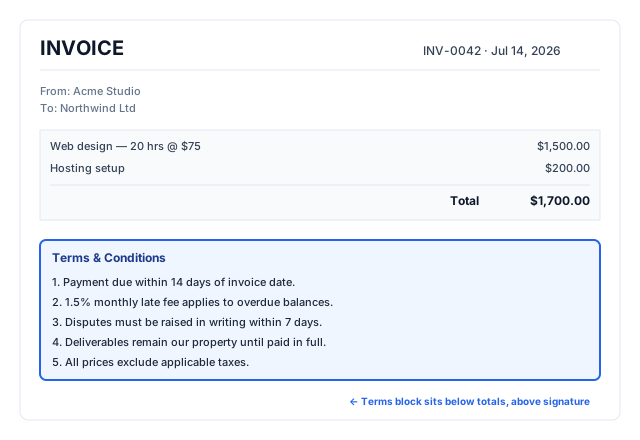
- Invoice Terms and Conditions Examples
Informational only — not tax or legal advice. India GST specifics follow the CGST Rules 2017 as published by the Central Board of Indirect Taxes and Customs (cbic-gst.gov.in), last verified July 2026.
Frequently Asked Questions
Is quotation same as invoice?
No. A quotation is a price offer sent before work begins and carries a validity period; an invoice is a payment request sent after delivery and carries a due date. A quotation has no accounting or tax status until accepted, while an invoice is booked as a receivable and can create GST liability. In short, the difference between quotation and invoice is direction — an offer going in, a bill coming out.
What comes first — quotation or invoice?
The quotation always comes first. The standard sequence is inquiry, quotation, acceptance (often via a purchase order), an optional proforma invoice for advances, delivery, then the final invoice. You can skip the quotation on small jobs where the price is already agreed and invoice directly — but never send an invoice before the price has been accepted somewhere in writing.
Who sends a quotation — the seller or the buyer?
The seller sends the quotation. The supplier of the goods or services prepares and issues both the quotation before the sale and the invoice after delivery. The buyer's documents flow the other way: a request for quotation (RFQ) to invite pricing, and a purchase order to accept it. When a buyer appears to send a quotation, it is almost always an RFQ.
Can the invoice amount differ from the quotation amount?
Yes — legitimately when scope changed after acceptance, when the quote estimated variable costs like materials or hours, or when exact taxes replace the quote's indicative figures. Best practice is to issue a revised quotation the moment scope moves, so the final invoice matches a number the client has already approved. An unexplained difference between the two amounts is the fastest route to a payment dispute.
Can a quotation be used as an invoice?
No. A quotation offers a price; an invoice requests payment. A client's accounts team cannot process a quotation for payment, it creates no receivable in your books, and under GST it has no standing — no input tax credit can be claimed against it. If a client accidentally pays a quotation, issue a proper invoice immediately and match the payment to it.
What is a proforma invoice?
A proforma invoice is a preliminary, non-binding invoice-style document issued after a buyer shows intent but before the final invoice. It is used to request advance payments, support customs declarations, and open letters of credit in international trade. It is not a tax invoice — it cannot support an input tax credit claim and is never reported in GST returns.