What Is E-Invoicing? Software, Peppol & 2026 Mandates
By Farasat Abbas Naqvi · Updated July 24, 2026
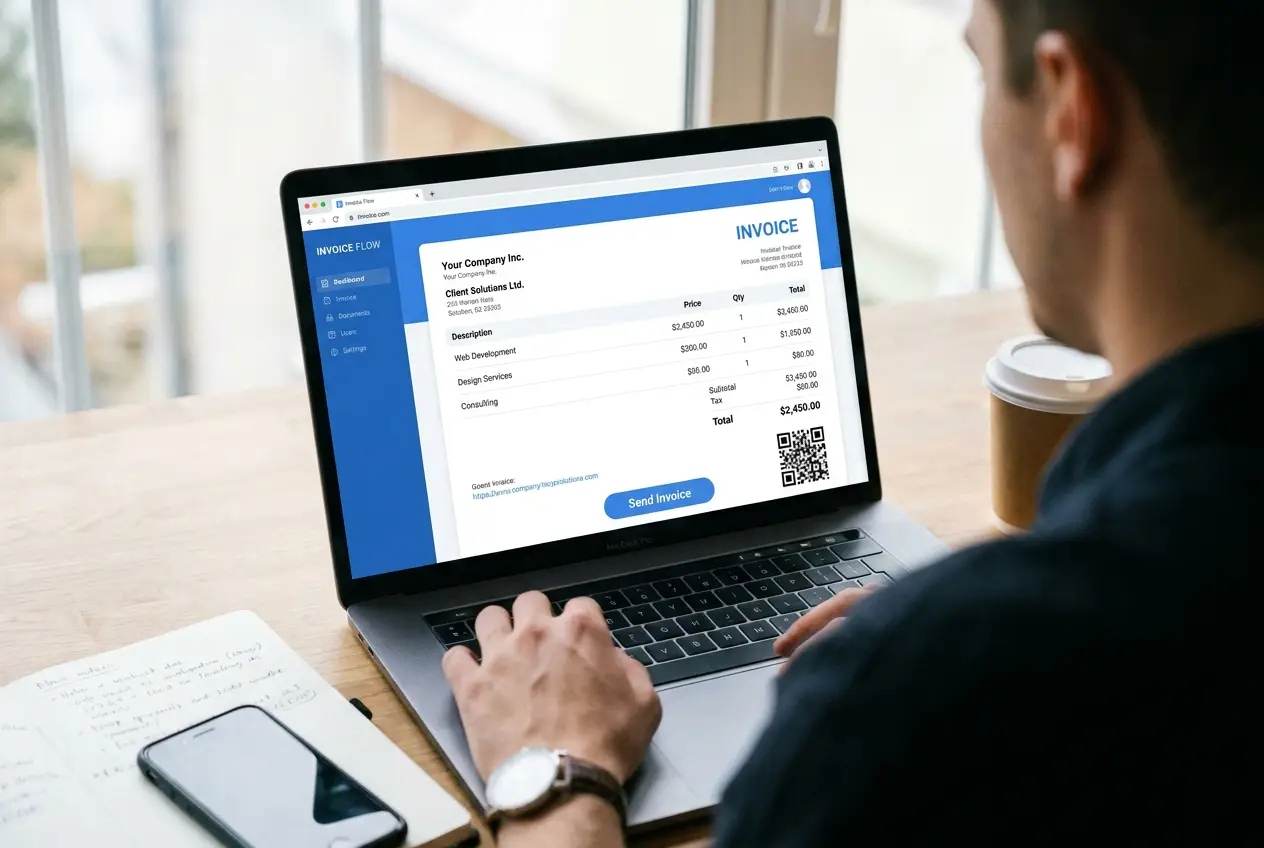
An invoice sent as a PDF attachment feels modern, but to the software that has to pay it, a PDF is just a picture of text. E-invoicing is a billing method that exchanges invoices as structured, machine-readable data directly between the seller's and the buyer's systems, so nobody has to retype anything. That single distinction is why governments on four continents are rewriting their VAT and GST rules around it: mandatory B2B e-invoicing goes live or expands in at least eight major economies during 2026. This guide covers what e-invoicing actually is, the issue-transmit-validate-archive cycle, how the Peppol and DBNAlliance networks route invoices, the 2026 mandate timeline country by country, what to look for in e-invoicing software, and how a small business can start today without spending anything.
What Is E-Invoicing?
E-invoicing (electronic invoicing) is the exchange of invoice data in a structured digital format — typically XML, UBL, or JSON — that travels from the seller's billing system straight into the buyer's accounts payable software and is processed automatically, with no manual data entry, no OCR scanning, and no printing. A PDF emailed to a client is a digital invoice; it only becomes an e-invoice when the underlying data stays machine-readable through its entire lifecycle, from creation to archiving.
The difference matters because a true e-invoice can be validated, matched to a purchase order, booked, and queued for payment by software in seconds. A PDF has to be opened by a person (or an error-prone OCR tool), keyed into the accounting system, and checked by hand. Tax authorities care for a second reason: structured data can be reported to them in real time, which is how countries like Italy and Brazil clamp down on VAT fraud.
What counts as an e-invoice
- XML invoices — data wrapped in descriptive tags any system can interpret; the EU's EN 16931 semantic standard defines what those fields must contain.
- UBL (Universal Business Language) — the OASIS format behind Peppol BIS Billing 3.0 in Europe and the US exchange network.
- Hybrid formats — Factur-X (France) and ZUGFeRD (Germany) embed XML inside a PDF/A-3 file, so the same document is readable by humans and machines.
- Classic EDI — EDIFACT and ANSI X12 messages exchanged over dedicated connections, common in retail and automotive supply chains.
- JSON — the lightweight format India's GST system uses for reporting invoices to its registration portal.
What doesn't count
A surprising amount of "electronic" billing fails the structured-data test: PDF or Word attachments, JPG or TIFF invoice images, unstructured HTML in an email body, paper invoices pushed through a scanner, and faxes. An Excel invoice template isn't an e-invoice either — the spreadsheet is structured for you, not for the recipient's software. Under the new European mandates this is now a legal line, not a technicality: Belgium's rules, for example, state plainly that paper and unstructured PDFs are no longer compliant for domestic B2B billing.
How E-Invoicing Works: Issue, Transmit, Validate, Archive
Every e-invoicing system, whatever the country or format, follows the same four-step cycle: the seller issues a structured invoice, a secure channel transmits it, software (and often a tax authority) validates it, and both parties archive it for the legally required period. Here is what each step involves in practice.
- Issue. The seller creates the invoice in accounting software, an ERP, or an online invoice generator. The tool captures the required fields — seller and buyer identity, tax identification numbers, invoice number and date, line items with quantities and unit prices, tax breakdowns — and outputs them in the required structured format.
- Transmit. The invoice travels over a secure channel: an open network such as Peppol, a government clearance platform, a private EDI connection, or an e-invoicing service provider. Unlike email, these channels confirm delivery and record an audit trail.
- Validate. Software checks the invoice against the format's schema and business rules — do the totals add up, is the tax rate valid, is the buyer's identifier real? In clearance countries the tax authority validates first: India's portal, for instance, returns a signed Invoice Reference Number and QR code before the invoice is legally valid.
- Archive. Both sides store the invoice in its original electronic format for the statutory retention period — typically 6 to 10 years depending on the country, and around 7 years for US tax purposes.
What Is Peppol E-Invoicing?
Peppol is an open international network that lets any registered business send e-invoices to any other participant through accredited service providers, using one standard format — so you connect once and can reach everyone on the network. It began in 2008 as a European Commission-funded procurement pilot and is now governed by OpenPeppol, a Brussels-based non-profit whose members span the public and private sectors.
Peppol e-invoicing runs on a four-corner model. The seller (corner one) sends through its own access point provider (corner two), which routes the document to the buyer's access point (corner three), which delivers it into the buyer's system (corner four). It works like mobile networks: you don't need to be on the same carrier as the person you're calling. That is a genuine improvement on older three-corner platforms, where both parties had to sign up with the same intermediary, and on two-corner EDI, where every trading pair needed its own connection.
Originally European, Peppol now handles B2B and B2G document exchange in Singapore, Australia, New Zealand, Japan, and Malaysia, and Belgium has built its 2026 mandate directly on Peppol BIS Billing 3.0. Businesses never join the network directly — you connect through a certified access point, which is a feature to check for when you compare e-invoicing software.
E-Invoicing in the United States: The DBNAlliance
The US has no federal or state e-invoicing mandate — adoption is voluntary and market-driven — but it now has an official open network. The Digital Business Networks Alliance (DBNAlliance), a 501(c)(6) non-profit launched in 2023 by the Business Payments Coalition with Federal Reserve support, oversees a Peppol-style four-corner exchange network for North America. The first live invoice crossed the network in early 2024, and any US business can now connect through a member service provider.
Like Peppol, the DBNAlliance uses the OASIS UBL format and a connect-once-reach-all design; today it covers B2B transactions, with government invoicing a likely later phase. For US firms the near-term drivers are commercial rather than legal: large buyers increasingly require structured invoices from suppliers, and exporters invoicing into Europe or Asia will hit foreign mandates long before a domestic one. If you're evaluating e-invoice sending software, the practical checklist is short — structured output, delivery confirmation, and a clear upgrade path to network access when a customer or country demands it. You can test the workflow with a free invoice generator before requesting a demo of anything enterprise-grade.
Global E-Invoicing Mandates: The 2026 Timeline
2026 is the year e-invoicing stops being optional for much of the world's mid-market. The EU's VAT in the Digital Age (ViDA) package — adopted 11 March 2025 — lets member states mandate domestic e-invoicing without asking Brussels first, and a wave of national deadlines follows through the decade. The European Commission expects the reform to cut VAT fraud by up to €11 billion a year and shave over €4.1 billion in annual administrative costs; the full framework is on the European Commission's ViDA page.
| Jurisdiction | Key dates | Who is affected | Required format |
|---|---|---|---|
| EU (ViDA) | 1 Jul 2030 intra-EU B2B digital reporting; domestic regimes harmonized by 1 Jan 2035 | All VAT-registered businesses trading across EU borders | EN 16931 |
| Germany | Receiving mandatory since 1 Jan 2025; issuing from 1 Jan 2027 (turnover over €800,000) and 1 Jan 2028 (all) | All domestic B2B; micro-businesses under €22,000 exempt from issuing | XRechnung, ZUGFeRD/Factur-X |
| France | 1 Sep 2026 receive (everyone) and issue (large/mid-size); SMEs issue from 1 Sep 2027 | All VAT-registered businesses, domestic B2B | UBL 2.1, UN/CEFACT CII, Factur-X via certified platforms (PDPs) |
| Belgium | 1 Jan 2026 | All VAT-registered, domestic B2B | Peppol BIS Billing 3.0 |
| Poland (KSeF) | 1 Feb 2026 (turnover over PLN 200m); 1 Apr 2026 (most others); penalties from 2027 | All VAT-registered, phased by size | FA(3) XML via central platform |
| Spain | VeriFactu certified billing software from 1 Jan 2026 (companies) and 1 Jul 2026 (self-employed) | Businesses not already on the SII reporting system | Verifiable XML |
| Saudi Arabia | Fatoora integration waves continue; Wave 24 by 30 Jun 2026 | VAT-registered firms with taxable revenue over SAR 375,000 | Signed XML / PDF-A3 via ZATCA |
| India | In force; ₹5 crore turnover threshold; 30-day reporting window tightened in 2026 | GST-registered businesses above threshold, B2B and exports | JSON to IRP, returns IRN + QR code |
| United States | No mandate; DBNAlliance network live since 2024 | Voluntary | OASIS UBL |
Elsewhere, Malaysia's MyInvois rollout reaches its smallest businesses during 2026, and the UAE has announced a phased B2B e-invoicing programme — so the pattern is global, not European. It isn't new, either: Mexico, Brazil, and Chile have run continuous transaction controls (CTC) — tax-authority clearance of every invoice — for over a decade, and Italy's FatturaPA brought the model to Europe in 2019. Two features repeat almost everywhere: obligations arrive receive-first (you must accept e-invoices before you must send them), and thresholds pull ever-smaller businesses in with each phase.
E-invoicing requirements in India (GST)
India's e-invoicing limit is ₹5 crore aggregate annual turnover: any GST-registered business above it must report every B2B invoice, export invoice, and credit or debit note to an Invoice Registration Portal before issuing it. The portal validates the JSON payload, returns a unique Invoice Reference Number (IRN) and signed QR code, and only then is the document a valid tax invoice. From 2026, businesses above ₹10 crore must upload invoices within 30 days of the invoice date — miss the window and the portal rejects them, and your buyer loses the input tax credit. B2C e-invoicing in India remains voluntary for now, though a pilot has been announced. The official portal and registration steps are at einvoice1.gst.gov.in, and our GST invoice format guide walks through the mandatory fields.
The Benefits of E-Invoicing, in Numbers
The case for e-invoicing is unusually quantified because governments commissioned the studies before writing the mandates. The headline finding, from European Commission research, is that processing an e-invoice costs 60–80% less than processing a paper one once you count printing, postage, keying, error correction, and filing. Here is what that saving looks like for a business handling 200 invoices a month, using a conservative $15 all-in cost per manual invoice:
| Metric | Paper / emailed PDF | E-invoicing |
|---|---|---|
| Processing cost per invoice | $15.00 | $3.00–$6.00 (60–80% lower) |
| Annual cost, 200 invoices/month | $36,000 | $7,200–$14,400 |
| Manual touchpoints | Print, mail/attach, key in, correct, file | Approve exceptions only |
| Typical error handling | Re-key and re-send | Schema validation catches errors before sending |
The wider evidence points the same way. Businesses adopting e-invoicing cut invoice processing time by up to 50%, and automated matching reduces invoices needing manual intervention by around 30%. On the receivables side, automation correlates with a 32% average reduction in days sales outstanding — roughly 19 days of cash flow recovered. One estimate puts potential US-wide savings at $13 billion a year, and PwC research suggests full adoption could add up to 0.5% to EU GDP. Add the softer wins — no interception of PDF attachments by invoice-fraud phishing, cleaner audit trails, fewer duplicate payments, less paper — and the 28%-a-year growth of the e-invoicing market stops looking surprising.
E-Invoicing vs Digital Invoicing vs EDI
These three terms get used interchangeably and shouldn't be: digital invoicing means any invoice in electronic form (usually a PDF), e-invoicing means structured system-to-system data exchange, and EDI is the older point-to-point technology for exchanging many document types between two fixed trading partners. The table shows where they differ.
| Digital invoicing | E-invoicing | EDI | |
|---|---|---|---|
| Format | PDF, Word, scan | Structured XML, UBL, JSON | X12, EDIFACT messages |
| Readable by | Humans | Machines (hybrids: both) | Machines |
| Transmission | Email attachment | Open networks, clearance platforms, providers | Dedicated one-to-one connections |
| Processing at receiver | Manual entry or OCR | Automatic booking and matching | Automatic, per trading partner |
| Regulatory role | Being phased out under mandates | The format mandates require | Accepted in some regimes; predates them |
| Best fit | Low volume, no mandate exposure | Most businesses from 2026 onward | High-volume retail and automotive supply chains |
How to Choose E-Invoicing Software
Good e-invoicing software does three jobs: it produces correctly structured invoices, it moves them over a channel that confirms delivery, and it keeps you compliant as formats and mandates change — everything else is convenience. When you shortlist e-invoicing solutions, check for:
- Network and format support — a certified Peppol access point connection if you trade in or with Europe or Asia-Pacific, plus the country formats you actually need (XRechnung, Factur-X, FatturaPA, Peppol BIS).
- Validation before sending — schema and business-rule checks that catch a bad tax rate or missing identifier before your customer or a tax authority does.
- Automation depth — purchase order matching (2-way or 3-way), duplicate detection, and OCR for the paper invoices that still arrive inbound.
- Security and signatures — ISO 27001 practices, GDPR handling, two-factor authentication, and digital signature support where eIDAS or ESIGN rules apply.
- Integration and scale — an API into your ERP or accounting stack, multi-currency support, and archiving that meets 6–10 year retention rules.
- Honest pricing — e-invoice software price models mix subscriptions, per-transaction fees, and implementation costs; a cloud tool a small business can deploy in 2–4 weeks beats a six-month integration you don't need yet.
A contrarian note from watching small firms buy tools: the most common mistake is not under-buying but over-buying. A US freelancer or a UK microbusiness with no mandate exposure does not need enterprise clearance middleware in 2026 — it needs clean, complete, structured invoices and a reliable sending channel, which free tools already provide. Buy the compliance layer when a mandate or a large customer actually demands it; switch costs are low precisely because the formats are standardized.
How Small Businesses Can Start E-Invoicing Free
You can start e-invoicing today without a budget: create a structured, complete invoice in a free online tool, deliver it through a channel that confirms receipt, and keep the electronic original archived. With Pro eInvoice's free e-invoice generator you can build a professional invoice in about two minutes with no sign-up — every required field, automatic totals and tax, and a clean PDF ready to email or print (signed-in users can send it from the app and track its status). A sensible sequence:
- Standardize your invoice data first. Consistent tax IDs, invoice numbering, item descriptions, and payment terms matter more than any transmission technology — they're what the structured formats encode.
- Move off Word and Excel. An online invoice software workflow gives you sequential numbering, saved clients, and status tracking that spreadsheets can't.
- Confirm what your buyers can receive. Ask your five biggest customers whether they accept structured invoices or plan to; in receive-first mandate countries they soon must.
- Add network delivery when required. If a mandate or a large buyer requires Peppol or a clearance platform, connect through a certified access point at that point — not before.
E-Invoicing Compliance Checklist for 2026
Use this before your next financial year begins, whichever market you sell into:
- List every country where you are VAT- or GST-registered and check its mandate dates against the table above.
- Confirm which formats apply to you (EN 16931 family, Peppol BIS, Factur-X, JSON/IRP) and whether your billing tool can produce them.
- Verify you can receive structured invoices — receive obligations usually land first.
- Check turnover thresholds each year: Germany's €800,000, India's ₹5 crore, and Saudi Arabia's SAR 375,000 waves all pull smaller firms in over time.
- Register with the relevant platform where required (IRP in India, KSeF in Poland, a PDP in France).
- Test one invoice end to end, including schema validation, before the deadline month.
- Set archiving to keep original electronic files for your jurisdiction's retention period.
- Document your process — grace periods in Belgium and Germany favor businesses that can show compliance work in progress.
This guide is informational only, not tax or legal advice. Mandate dates and thresholds were checked against the European Commission's ViDA publications, OpenPeppol, and national tax authority portals, last verified July 2026 — confirm details for your jurisdiction with your tax adviser before acting.
Frequently Asked Questions
What is e-invoicing in simple terms?
E-invoicing is sending an invoice as structured, machine-readable data (XML, UBL, or JSON) directly from your billing software into your customer's accounting system, instead of as paper or a PDF a person must retype. Because software reads every field automatically, the invoice can be validated, matched to a purchase order, and queued for payment in seconds, and tax authorities can verify it in real time.
What is the difference between an e-invoice and a PDF invoice?
A PDF is a digital picture of an invoice — a human can read it, but software cannot process it without manual entry or error-prone OCR. An e-invoice carries the same information as tagged, structured data that the receiving system books automatically. Under 2026 mandates in countries like Belgium, France, and Germany, emailed PDFs no longer count as compliant invoices for domestic B2B transactions.
Is e-invoicing mandatory in the United States?
No. The US has no federal or state e-invoicing mandate, so adoption is voluntary. Since 2023, however, the Digital Business Networks Alliance (DBNAlliance) — created by the Business Payments Coalition with Federal Reserve support — has run an open Peppol-style exchange network using the UBL format. US businesses mainly adopt e-invoicing because large buyers require it or because they export to countries with mandates.
What is the e-invoice turnover limit in India?
India's GST e-invoicing threshold is 5 crore rupees in aggregate annual turnover. Businesses above it must report every B2B invoice, export invoice, and credit or debit note to an Invoice Registration Portal, which returns a signed Invoice Reference Number (IRN) and QR code that make the invoice valid. From 2026, businesses above 10 crore rupees must upload invoices within 30 days or they are rejected.
What is Peppol e-invoicing and do I need it?
Peppol is an open international network that routes standardized e-invoices between businesses through accredited access point providers — you connect once and can reach every participant, like calling across phone carriers. It is governed by the non-profit OpenPeppol and used across Europe, Singapore, Australia, New Zealand, Japan, and Malaysia. You need it when a mandate (like Belgium's) or a large customer requires network delivery; a certified provider handles the connection.
Can a small business start e-invoicing for free?
Yes. A small business can create structured, complete invoices with a free online invoice generator, deliver them through a channel that confirms receipt, and archive the electronic originals — no paid software required. Pro eInvoice's free generator needs no sign-up and produces professional invoices with every required field in about two minutes. Paid network connections only become necessary when a mandate or a major buyer demands Peppol or clearance-platform delivery.