Credit Note vs Refund: UK Rules, VAT + Free Template
By Farasat Abbas Naqvi · Published May 14, 2026 · Updated July 24, 2026
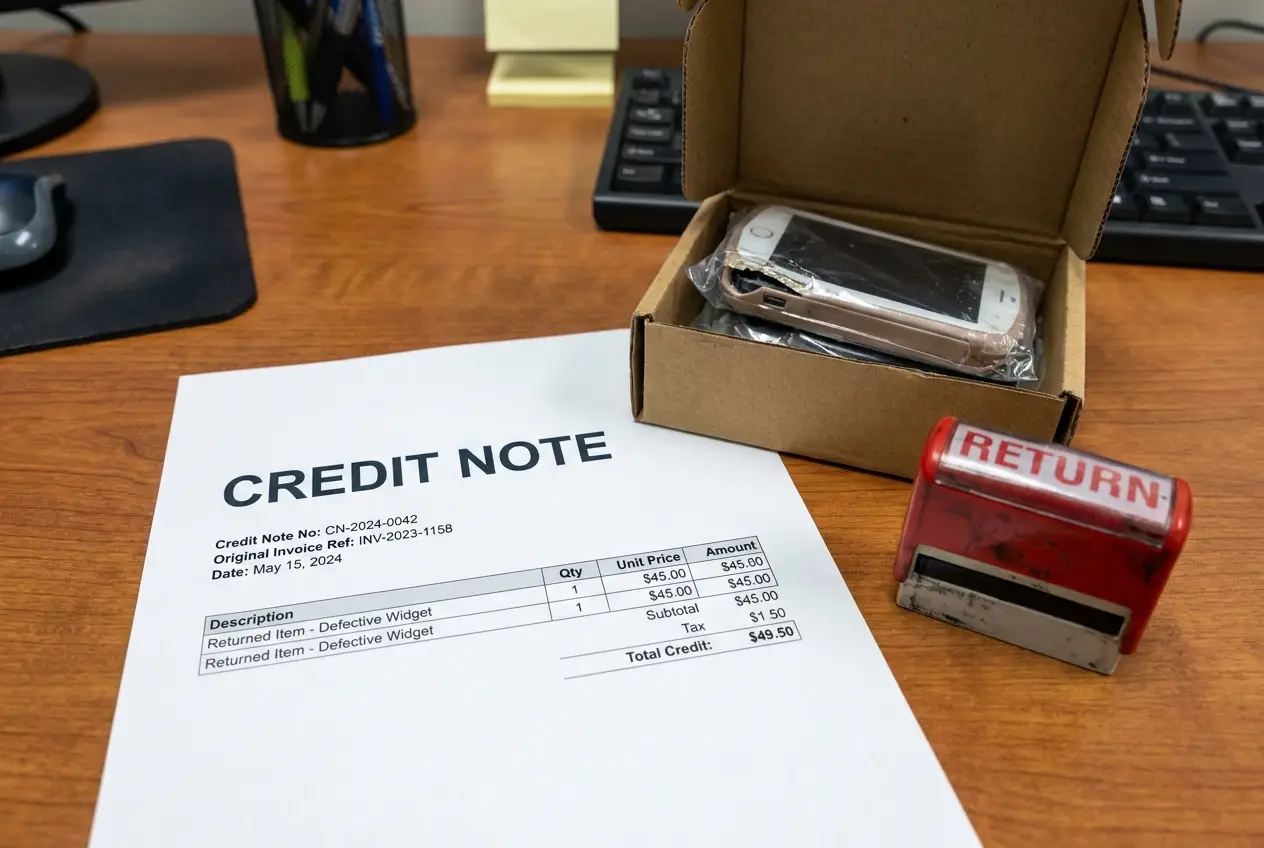
A client returns an item, disputes a charge, or you bill them twice by mistake. Do you send money back, or issue a credit against their account? The credit note vs refund choice looks cosmetic, but it changes your cash position, your VAT return, and — when a consumer is involved — what the law lets you offer at all.
A credit note is a commercial document that reduces or cancels the amount owed on an invoice a seller has already issued to a buyer. A refund is the actual return of money. One is paperwork; the other is payment. With UK return rates running around 17.5%, the credit and refund difference comes up weekly for most small businesses.
Refund
You return money the client has already paid, normally to the original payment method. The transaction reverses on both sides: cash leaves your account, the invoice is marked refunded (fully or partially), and the corresponding revenue is reduced. Where a consumer rejects faulty goods, the Consumer Rights Act 2015 (section 20) requires the refund without undue delay, within 14 days of the trader agreeing it is due — no fees, and no substituting store credit.
Credit note (credit memo)
What's a credit note in practice? A negative invoice. You issue a document the client can apply against a future invoice; no money moves. Use it when the client has paid and is happy to keep the credit on account, or when an invoice was overstated — invoices cannot legally be deleted, so the credit note is the audit-safe correction. You can also raise a credit note for a refund you are about to pay, so paperwork matches payment. Typical triggers: returned or damaged goods, wrong quantities, incorrect prices, forgotten discounts, retrospective volume rebates, cancellations before delivery, contract renegotiations, and goodwill gestures.
Is a credit note the same as a refund?
No. A refund returns money to the buyer; a credit note is the document that reduces what the buyer owes or stores value against future purchases. The two often travel together, but they are separate events in your books, and only the refund moves cash. Unpaid invoice? The credit note cuts the balance — a customer owing £200 owes £150 after a £50 credit note. Paid invoice? The customer takes the money back or leaves the credit on account.
Cash refund vs credit note: your rights in the UK
For consumer sales, the choice is often not yours to make. Under the Consumer Rights Act 2015, goods must be of satisfactory quality, as described, fit for purpose, and last a reasonable length of time. When they are not, the remedies are fixed by statute:
- Within 30 days — the short-term right to reject. The customer can hand back faulty, misdescribed or unfit goods and demand a full cash refund. The clock starts the day after ownership or possession, delivery, and any agreed installation are all complete (Consumer Rights Act 2015, s.22); perishable goods get a window matching how long they can reasonably be expected to last.
- After 30 days, up to 6 months — the trader gets one attempt at repair or replacement; if that fails, a refund is still due, and the law presumes the fault existed at purchase unless the business proves otherwise. A repair pauses the 30-day clock, leaving at least 7 days to reject afterwards.
- Up to 6 years (5 in Scotland, under the Limitation Act) — a partial refund may still be claimable if goods fail earlier than a reasonable person would expect.
- Online, phone and mail-order purchases — the Consumer Contracts Regulations 2013 add a 14-day change-of-mind cancellation right from delivery, plus 14 further days to return the goods. Personalised items, perishables and unsealed media are excluded.
Change of mind on an in-store purchase carries no automatic refund right; an "exchange or credit note only" policy is perfectly lawful there — exactly where credit notes belong.
| Situation | Cash refund? | Credit note acceptable? |
|---|---|---|
| Faulty item, within 30 days | Yes — statutory right | Only if the customer freely agrees |
| Faulty item, after 30 days | Yes, after one failed repair/replacement | Only by agreement |
| Online order cancelled within 14 days | Yes — including basic outbound delivery | No, cannot replace the refund |
| In-store change of mind | No legal right — shop policy decides | Yes — common goodwill option |
| Sale item with a fault | Yes — "sale" doesn't remove rights | Only by agreement |
| Gift return without proof of purchase | Unlikely without the buyer's help | Yes — practical middle ground |
Can a shop insist on a credit note instead of a refund?
Only for goodwill returns. For faulty, misdescribed or unfit goods within the statutory windows, the shop cannot restrict you to store credit — signs saying "no refunds given", "sold as seen" or "credit notes only" are unenforceable and can breach consumer protection law. If a retailer digs in: show proof of purchase (a bank statement or email works, not just a receipt), ask for the decision in writing, escalate, and on card purchases over £100 and under £30,000 consider a Section 75 claim.
Should I ask for a credit note after a refund?
As a consumer, no — once the money is back on your card, the matter is closed. As a VAT-registered business customer, yes: you need the supplier's credit note to correct the input tax you reclaimed on the original invoice, and you must adjust your VAT return whether or not the cash has landed. Chase it — without it, your VAT records overstate input tax.
Tax implications
A VAT credit note is not optional paperwork — it is how HMRC expects a decrease in consideration to be recorded. Under Regulation 38 of the VAT Regulations 1995 (as amended from 1 September 2019), you must issue the credit note within 14 days of the decrease — typically the day returned goods arrive back, one reason a signed delivery note matters — and account for the adjustment in the VAT period in which the decrease occurs.
The 2019 amendment added a refund test: you can only reduce the output VAT on your return if you have actually refunded the customer, in money or by offset against another invoice. Issuing the document alone no longer cuts your VAT bill. Your customer must reduce their input tax claim as soon as they receive the note. HMRC's VAT guide (Notice 700), section 18 lists what a valid credit note must show:
- the words "credit note" and a unique, sequential number (separate from your invoice numbering)
- date of issue, your name, address and VAT registration number
- the customer's name and address
- a reference to the original invoice number and date
- description, quantity and unit price of what is credited, plus the reason for the credit
- the credit amount excluding VAT, and the VAT rate and VAT amount for each rate
Miss the 14-day window and the adjustment becomes a VAT error, corrected under Notice 700/45 — on your next return if below £10,000 (or under 1% of box 6 up to £50,000), otherwise via form VAT652, with statutory interest and penalties possible. Edge cases: a note marked "This is not a credit note for VAT purposes" (agreed in advance) leaves both sides' VAT untouched, and invoices that will never be paid go through bad debt relief under section 36 of the VAT Act 1994 after six months, not a credit note. Keep every credit note for six years, in Making Tax Digital-compatible software if you file that way.
Credit note example: worked figures and the accounting entries
A typical UK credit note example: you invoiced INV-0087 for £1,000 net + £200 VAT = £1,200. The client returns a quarter of the goods (£250 net), so you issue credit note CN-0012 for £250 + £50 VAT = £300. If the invoice is unpaid, the client now owes £900; if it was paid, you transfer £300 back or hold the credit against next month's order. Either way, the double entry is the same:
| Side | Debit | Credit |
|---|---|---|
| Seller (issuer) | Sales returns £250; Output VAT £50 | Accounts receivable £300 |
| Buyer (recipient) | Accounts payable £300 | Purchases £250; Input VAT £50 |
Is a credit note a debit or a credit? Both, depending on the ledger side: the seller debits revenue and output tax down; the buyer credits purchases and input tax down. The free credit note template follows this credit note format — download the Word (.docx) version and drop in your figures.
Debit note vs credit note
The credit note and debit note difference trips people up because both adjust an invoice — in opposite directions. A debit note usually comes from the buyer, flagging that the amount payable should rise (a supplier invoiced £1,000 when the agreed price was £1,200, so the buyer raises a £200 debit note). The seller answers with a credit note or, for an undercharge, a supplementary invoice. Old-school bookkeepers wrote debit notes in blue ink and credit notes in red.
| Debit note | Credit note | |
|---|---|---|
| Issued by | Buyer (typically) | Seller |
| Effect on amount payable | Increases it | Reduces it |
| Common triggers | Undercharged invoice, extra goods received | Returns, overcharges, discounts, cancellations |
| Accounting impact | Raises buyer's payables, seller's receivables | Cuts seller's sales, buyer's payables |
| UK VAT effect | None on its own | Adjusts output and input VAT |
For UK VAT only the credit note counts: a debit note from a customer has no VAT effect until the supplier issues the formal credit note. When a credit note from a supplier reaches you, book it promptly — input tax comes down even before the money does.
When to use which
- Refund: the client cancelled, won't buy again, formally requests cash back — or is a consumer exercising a statutory right (faulty goods within 30 days, online cancellation within 14). Pay it to the original payment method.
- Credit note: ongoing client, overbilling, price renegotiation, partial defect, incomplete delivery, goodwill credit — anywhere the trading relationship continues and the value can offset the next invoice.
An unfashionable observation from running invoicing for small firms: consumer guides say "always demand cash", but between two VAT-registered businesses trading monthly, a credit note usually settles faster than a refund. A BACS refund waits for someone's weekly payment run; a credit note clears against the next invoice automatically and keeps both VAT accounts tidy in the same period.
On expiry: statutory refund rights cannot be time-limited, but a goodwill credit note can carry an expiry date — 12 months is common UK retail practice, stated clearly when issued. B2B credit notes on account sit as a creditor balance until used, repaid or written back. Before accepting one instead of money, check the expiry, online and in-store usability, and sale-item exclusions.
How to issue a credit note in ProeInvoice
Create a new document that mirrors the original invoice, enter the credited lines as negative quantities (or use the credit note template, which handles the format for you), reference the original invoice number — "Credit note against INV-0042" — and number it in its own CN- sequence so your books reconcile. Send it within 14 days of the return or price change, keep your copy for six years, and pay any refund in the same VAT period. Try the free generator — no signup needed.
Informational only, not tax or legal advice. Sources: Consumer Rights Act 2015 (legislation.gov.uk) and HMRC VAT guide Notice 700 (gov.uk), last verified July 2026.
Frequently Asked Questions
Can you put a cash refund against a credit note?
Yes. A business can settle an outstanding credit note by paying the customer cash rather than holding the balance on account. For UK VAT this is actually the cleaner route: since 1 September 2019, a seller can only reduce output VAT once an actual refund has been made or the credit has been offset against another invoice. A consumer holding a goodwill credit note, however, usually cannot demand it be converted into cash.
Do credit notes expire in the UK?
Goodwill credit notes issued by shops can expire — 12 months is common, and the expiry must be made clear when the note is issued. Statutory rights cannot be time-limited this way: a refund owed for faulty goods stays owed. Between businesses, a credit note sits on the account as a creditor balance until it is used against an invoice, repaid, or written back, so it does not lapse automatically.
Is a credit note a debit or a credit in the accounts?
Both, depending on whose books you are looking at. The seller records a credit note as a debit to sales returns and output VAT, and a credit to accounts receivable. The buyer mirrors it: a debit to accounts payable, and a credit to purchases and input VAT. On a £300 credit note (£250 net plus £50 VAT), each side's entries balance to £300.
What must a VAT credit note show to satisfy HMRC?
HMRC's VAT guide (Notice 700) requires the words 'credit note', a unique sequential number, the date of issue, the supplier's name, address and VAT registration number, the customer's name and address, a reference to the original invoice, a description with quantity and unit price, the reason for the credit, and the net amount plus the VAT rate and VAT amount for each rate. Keep copies for six years.
Who issues a debit note and who issues a credit note?
The buyer typically issues a debit note, telling the supplier the amount payable should increase — after an undercharge or extra goods received, for example. The seller issues the credit note, reducing what the buyer owes after returns, overcharges or discounts. In UK VAT, only the seller's credit note adjusts the tax position; a buyer's debit note has no VAT effect on its own.
How long do I have to reject faulty goods for a full refund?
30 days under the Consumer Rights Act 2015's short-term right to reject, counted from the day after you have the goods, delivery is complete, and any agreed installation is finished. Perishables get a shorter, realistic window. If you agree to a repair or replacement, the clock pauses and you keep at least 7 days once the item comes back. After 30 days, the retailer gets one repair attempt before a refund is due.