Delivery Challan Format in Excel, Word & PDF (Free Download)
By Farasat Abbas Naqvi · Published June 20, 2026 · Updated July 24, 2026
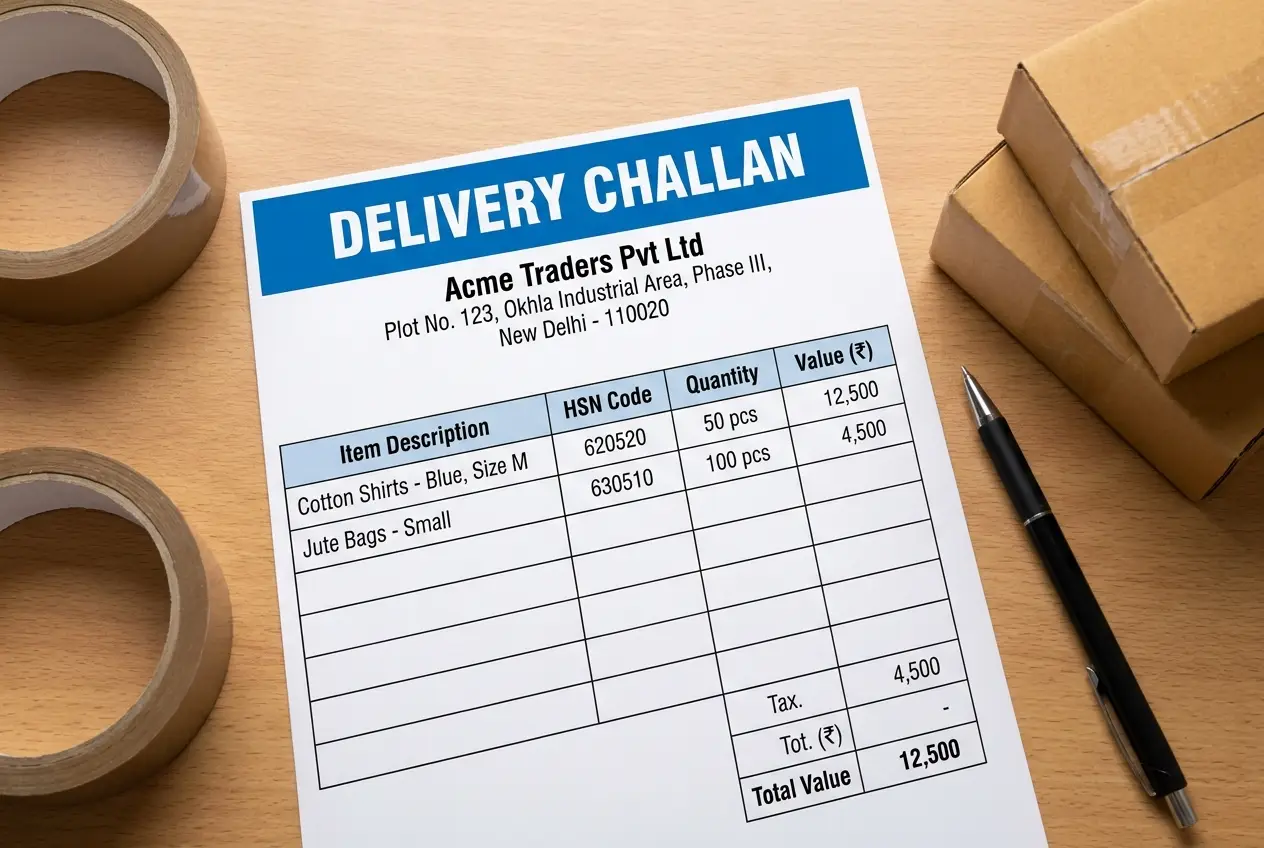
A delivery challan is a transport document that moves goods from one place to another without a tax invoice — the paperwork a GST-registered business needs when stock shifts between godowns, materials go out for job work, or items travel on approval. This page gives you a free delivery challan format in Excel, Word and PDF, with every field required under Rule 55 of the CGST Rules, 2017 already in place.
Names vary — dispatch challan, delivery slip, outward challan, goods challan format — but the job is constant: prove what left your premises, in what quantity, and why.
Download the free delivery challan format (Excel, Word, PDF)
All three files carry the full Rule 55 field set: consignor and consignee blocks with GSTIN, serial challan number, HSN/SAC and description columns, quantity, taxable value, tax-rate columns, place of supply, vehicle number, reason for movement and signatures.
- Download the free delivery challan format Excel file (.xlsx) — auto-totalling, for daily dispatches
- Download the free Word format (.docx) — editable, add your logo
- Download the free PDF format — print-ready for the transporter copy
Want a delivery challan format free download without managing files? The delivery challan generator handles challan creation in the browser: fill consignor, consignee and item details, preview, and export any format — no sign-up. It doubles as a free delivery challan app on a phone, fetches the next challan number automatically, and picks CGST + SGST or IGST from the consignee's state.
Delivery challan format in Excel — free download
The delivery challan format in Excel free download is the busiest file here: a spreadsheet earns its keep once dispatches cross a handful a week. The structured template totals quantity and taxable value with formulas, adds rows without breaking the layout, and stores each challan as a dated sheet. Columns run serial number, item name, HSN/SAC code, quantity and unit — kg, pcs, box, litre, dozen — plus optional PO number and batch details columns. FMCG distributors, electronics wholesalers and furniture manufacturers moving stock from central godown to retail shop standardise on the delivery challan excel template because month-end reporting is a pivot table or dispatch-volume chart away.
Two variations worth knowing. Stores teams keep the same sheet as an outgoing challan excel format — a running register of everything crossing the factory gate. Want an online delivery challan format in excel instead of local files? The generator builds the identical delivery challan excel sheet in the browser and exports XLSX.
Simple delivery challan format in Word
A simple delivery challan format in word suits businesses dispatching a few times a month who care how the document looks. Word makes branding easy: drop in your logo; set business name, address, phone, email and GSTIN in the header; keep separate "Delivery Challan For" (buyer) and "Shipping To" (delivery destination) blocks for cases where they differ. Add dispatch date and delivery time, a short terms line, and an authorised signatory block. The delivery challan format word free download includes a "Received By" section — name, date, comments, signature — turning your returned copy into signed proof of delivery.
Delivery challan format PDF
The delivery challan format pdf locks the layout so the printed copy matches the screen — no shifted columns or font substitutions at the transporter's office. Use PDF for whatever physically travels: the driver hands a signed paper copy to the consignee, and nobody inspects a spreadsheet in a truck cab. Vehicle dealers releasing cars from a stockyard print a car delivery challan in PDF — the vehicle delivery note template adds chassis and registration fields.
Excel, Word or PDF — which format should you use?
Use Excel when you dispatch often and need totals calculated, Word when volume is low and presentation matters, and PDF for every copy that travels with the goods or gets emailed — it cannot be edited in transit. Many businesses use all three: draft in Excel, brand once in Word, export PDF per dispatch.
| Format | Best for | Strength | Watch out |
|---|---|---|---|
| Excel (.xlsx) | Daily or bulk dispatches | Formulas, auto-totals, reporting | Easy to overwrite old challans |
| Word (.docx) | Occasional dispatches | Logo, branding, clean layout | No calculations — check totals manually |
| Transport and sharing copies | Fixed layout, prints identically | Not editable — regenerate to correct |
A static file will not update stock levels or track delivery status — reconcile returned copies against inventory weekly.
What a delivery challan format under GST must contain (Rule 55)
Rule 55(1) permits movement on a challan instead of an invoice in four situations: supply of liquid gas where quantity is unknown at removal, transportation for job work, transportation for reasons other than supply, and other movements notified by the Board. It also fixes the contents of a gst delivery challan format: a delivery challan format as per gst rules carries every field below. Our guide to what a delivery challan is covers each situation in depth.
| # | Field (Rule 55) | What to enter |
|---|---|---|
| 1 | Date and challan number | Dispatch date; serial number up to 16 characters |
| 2 | Consignor details | Name, address and GSTIN of the sender |
| 3 | Consignee details | Name, address, GSTIN or UIN if registered; name, address and delivery location if not |
| 4 | HSN code and description | HSN/SAC code plus a real description — "40 kg brass castings", not "material" |
| 5 | Quantity | Actual quantity; marked provisional where the exact quantity is not known (e.g. liquid gas) |
| 6 | Taxable value | Value of the goods in ₹, even though no tax is charged on non-supply movement |
| 7 | Tax rate and amount | CGST, SGST/UTGST, IGST and cess — only where the movement is a supply to the consignee |
| 8 | Place of supply | Required for inter-state movement |
| 9 | Signature | Signature of the authorised signatory |
Add one non-statutory line: the reason for movement. After years of building challan templates, the pattern is hard to miss — GSTIN and HSN rarely get skipped; the reason line does, and it is the first thing a checkpost officer reads. Left blank, the movement can be treated as an unbilled sale.
Serial numbering rules: 16 characters, no gaps
Challan numbers must be serial, alphanumeric, and no longer than 16 characters, in one or multiple series. A clean company delivery challan format runs one series per financial year — DC/26-27/0412 is 13 characters and sorts correctly all year. Random or duplicate numbers invite audit confusion — challans get linked to invoices later, and mismatches surface in scrutiny. Retain copies for 72 months.
Can one challan cover multiple deliveries?
No — issue a separate challan for each movement of goods. One challan across several trips breaks the document-vehicle-consignment link that Rule 55 and the e-way bill system assume, and turns stock reconciliation into guesswork. The exception — one consignment split across vehicles — has its own Rule 55(5) procedure, covered below.
Original, duplicate, triplicate: the three transport copies
Rule 55(2) requires the challan in triplicate, each copy marked for its holder:
- ORIGINAL FOR CONSIGNEE — travels with the goods to the receiver
- DUPLICATE FOR TRANSPORTER — the driver's copy at checkposts
- TRIPLICATE FOR CONSIGNER — your file copy
Three copies means all three parties hold a valid document — no disputes over what was sent, when, and why. Your triplicate is proof of dispatch and the audit trail.
Is a handwritten delivery challan allowed?
Yes. A pre-printed delivery challan book with carbon copies is still legal and common — the bound delivery challan book format gives triplicate copies and printed serial numbers by default. Handwritten challans fail in practice, not law: illegible HSN codes, skipped fields, torn copies. Mirror the Rule 55 field table in the book's printed layout.
Job work delivery challan format
The job work delivery challan format covers goods a principal sends to a job worker for processing — repair, polishing, plating, machining, assembly — movement between job workers, and the return leg. No GST is charged because job work movement is not a supply; the material delivery challan format simply records what went out. Worked example: a Pune machine shop sends 40 kg of brass castings (HSN 7419) for heat treatment — the challan for delivery of material shows quantity 40 kg, taxable value ₹18,500, tax columns nil, reason "for job work — returnable". One caution: inter-state job work needs an e-way bill irrespective of value — the ₹50,000 threshold does not apply.
Returnable vs non-returnable delivery challan
A returnable delivery challan format is for goods you expect back: machinery out for inspection, testing or repair, artwork sent to galleries, trade-fair or exhibition display stock, goods on approval or sale-or-return. Mark it "Returnable — not for sale" and log the return against the same challan number — that is your traceability. Goods sent abroad for exhibition or sales promotion also move on a challan (CBIC Circular No. 108/27/2019).
A non-returnable challan covers one-way movement without an immediate invoice: free samples and promotional goods marked "Not for Sale", an intrastate stock transfer (STO) from warehouse to branch under one GSTIN, or a sales return — a customer sends goods back over damage or an order mismatch and you record receipt before refund or replacement. Only the reason line and the expectation of return differ.
Do you need an e-way bill with a delivery challan?
Yes — whenever the consignment value on the challan exceeds ₹50,000. Neither document replaces the other: they are two separate documents travelling together, and Rule 55(3) requires movement on a challan to be declared under Rule 138. The driver carries the duplicate challan copy plus the e-way bill number.
The e-way bill needs clean challan data: both GSTINs, HSN, taxable value, mode of transport, and vehicle number — or the transport document number (railway receipt, airway bill) for rail and air. Validity runs on distance, so incomplete addresses cause friction. Two sub-rules matter. Under Rule 55(4), if goods move for supply but the invoice could not be issued at removal, you invoice after delivery. Under Rule 55(5), goods in semi knocked down or completely knocked down condition (SKD/CKD) — or in batches and lots — move on one invoice issued before the first consignment: a delivery challan with each lot referencing it, a certified invoice copy with every lot, and the original invoice with the last consignment.
Delivery challan vs invoice — and the challan cum invoice
An invoice records a sale; a challan records a movement. Section 31 of the CGST Act, 2017 makes the tax invoice the default document for supply — proof of ownership transfer, full value with tax, the basis of the buyer's input tax credit (ITC), plus e-invoicing and QR code duties above the turnover threshold. A challan proves the consignee received goods, nothing more: no ownership transfer, no ITC, no payment due against it. When a movement becomes a sale — the approval customer keeps the goods — raise a GST-compliant tax invoice — the free invoice builder converts a challan into one without retyping line items. Some retailers print a delivery challan cum invoice — one document that bills and travels — fine for plain sales, no substitute in non-supply movement. A bill of supply serves exempt and composition sales, and a plain delivery note is the non-GST cousin for everyday deliveries.
Informational only, not tax or legal advice. Field requirements follow Rule 55 of the CGST Rules, 2017, published by CBIC on the GST portal (cbic-gst.gov.in) — last verified July 2026.
Frequently Asked Questions
Is an e-way bill required with a delivery challan?
Yes — when the consignment value on the challan exceeds ₹50,000, an e-way bill must be generated under Rule 138 and carried along with the challan; they are two separate documents. One exception cuts the other way: goods sent to a job worker in another state need an e-way bill irrespective of value, so even a small inter-state job work movement requires both.
How many copies of a delivery challan are required under GST?
Three. Rule 55(2) of the CGST Rules requires the challan in triplicate: the original, marked ORIGINAL FOR CONSIGNEE, travels with the goods to the receiver; the duplicate, marked DUPLICATE FOR TRANSPORTER, stays with the driver; and the triplicate, marked TRIPLICATE FOR CONSIGNER, remains in the sender's records. That way all three parties hold a valid document for the same movement.
Can I download a delivery challan format in Excel for free?
Yes. The Excel format on this page is a free download with no sign-up — it auto-totals quantity and taxable value and includes every Rule 55 field: consignor and consignee blocks with GSTIN, HSN/SAC and description columns, taxable value, tax-rate columns, place of supply, vehicle number and signature lines. You can also build the same sheet in the online generator and export XLSX.
Is a delivery challan format in Word legally valid?
Yes. GST law prescribes the contents of a delivery challan, not the software used to make it — Word, Excel, PDF and even a pre-printed challan book are all acceptable. A Word challan is valid as long as it carries every Rule 55 particular: a serial number within 16 characters, consignor and consignee details with GSTIN, HSN code, description, quantity, taxable value and signature.
Is GST charged on a delivery challan?
No tax becomes payable on the challan itself. For non-supply movement — job work, branch transfers under one GSTIN, returnable goods — the tax columns stay nil and only the taxable value is shown. Where the movement is actually a supply to the consignee, the challan shows the tax rate and amount (CGST, SGST or IGST), but the liability arises on the tax invoice.
How should a delivery challan be numbered?
Serially, using an alphanumeric code of at most 16 characters, in one or multiple series — for example DC/26-27/0412. Keep one continuous series per financial year rather than restarting or improvising numbers, because challans are matched against invoices and e-way bills during scrutiny, and gaps or duplicates raise questions. Retain your copies for 72 months.
Related Guides & Tools
- Free Delivery Note Generator
- Delivery Note Software
- What Is a Delivery Note? Meaning, Format & Free Template
- What Is a Delivery Challan? Meaning, Uses & GST Rule 55
- Bill of Lading Template + How to Fill One (Free PDF)
- Packing Slip vs Packing List vs Shipping Label (+Template)
- Vehicle Delivery Note (RTO): Format, PDF & Free Template