Invoice Terms and Conditions: 25 Copy-Paste Examples (2026)
By Farasat Abbas Naqvi · Updated August 3, 2026
Invoice terms and conditions are the short legal block on an invoice that sets the payment due date, late-fee rate, dispute window, tax treatment, and ownership of deliverables for both the business issuing the invoice and the client paying it. A workable default for freelancers and small businesses: "Payment due within 14 days. 1.5% monthly late fee on overdue balances. Disputes must be raised in writing within 7 days. Deliverables remain our property until paid in full." Below are more than 25 copy-paste wording examples — 39, numbered — grouped by payment, late fees, deposits, disputes, ownership, taxes, refunds, and scope, plus a full invoice terms and conditions sample block you can adapt to your jurisdiction.
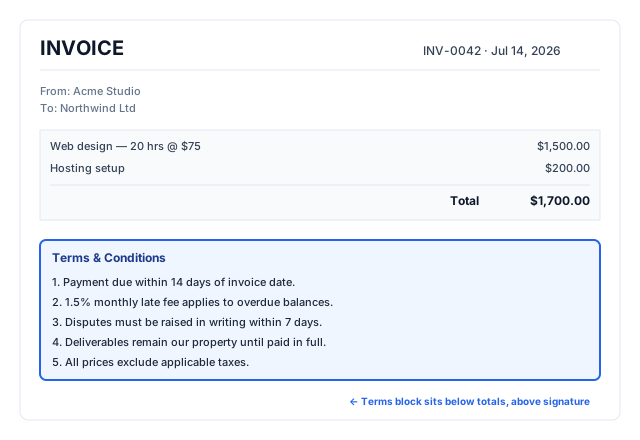
Two things make these clauses enforceable: the client saw them before the work was delivered, and the invoice restates them — so print the terms and conditions on invoice PDFs and paper copies alike. Most searches for terms and conditions for invoice wording come from people who need paste-ready text, so every invoice terms and conditions example here drops straight into the terms field: swap the bracketed details and go.
Standard Payment Term Examples
The payment terms and conditions for invoice documents begin with one line: when the money is due. A standard invoice terms and conditions example pairs one of these with a late-fee clause from the next section.
- 1. Due on receipt: "Payment is due upon receipt of this invoice."
- 2. Net 7: "Payment is due within 7 days of the invoice date."
- 3. Net 14: "Payment is due within 14 calendar days of the invoice date."
- 4. Net 30: "Payment is due within 30 calendar days of the invoice date (Net 30). Please quote invoice number [INV-0042] with your payment."
- 5. Fixed date: "Payment is due by [August 31, 2026]."
- 6. End of month (EOM): "Payment is due by the end of the month in which this invoice is issued."
- 7. Milestone: "50% due on acceptance, 50% due on completion."
- 8. Early payment discount (2/10 Net 30): "A 2% discount applies if full payment is received within 10 days of the invoice date; otherwise the full amount is due within 30 days."
Accepted payment method wording
- 9. "We accept bank transfer (ACH), credit card, check, and online payment via the link on this invoice. Please use the invoice number as your payment reference."
- 10. "Payment is treated as received only when cleared funds reach our account. Card payments may carry a surcharge of up to 2% where permitted by law."
Comparison: Common Payment Terms
These invoice payment terms examples trade collection speed against client convenience — shorter windows improve liquidity and can roughly halve Days Sales Outstanding; longer ones grow accounts-receivable exposure. Choose by industry norm, transaction size, client payment history, and risk tolerance, not habit.
| Term | Meaning | Best for | Cash flow impact |
|---|---|---|---|
| Due on receipt | Payment expected immediately | Small jobs, new clients | Fastest cash |
| Net 7 | Full payment within 7 days | Freelancers, recurring clients | Strong |
| Net 14 | Payment within 14 calendar days | SMB standard | Balanced |
| Net 30 | Payment within 30 calendar days | Enterprise clients | Slow but expected |
| Net 60 | Payment within 60 days | Large B2B contracts | Hard on small suppliers |
| 2/10 Net 30 | 2% discount inside 10 days, else full in 30 | Nudging early payment | Speeds collections |
| EOM | Due at the end of the invoice month | Retainers, monthly billing | Predictable |
| 50/50 milestone | Half upfront, half on completion | Project work | Reduces risk |
| COD | Cash on delivery | Goods, first orders | Immediate |
Rarer codes you will meet on B2B paperwork: PIA (payment in advance), CIA (cash in advance), CWO (cash with order), CND (cash before delivery), CBS (cash before shipment), and MFI — "15 MFI" means payment is due by the 15th of the month following the invoice.
Late Payment & Interest Clauses
Adapt the rate to local law: US states cap interest at different usury limits, while UK suppliers can claim statutory interest under the Late Payment of Commercial Debts (Interest) Act 1998.
- 11. "A late fee of 1.5% per month will be applied to all overdue balances."
- 12. "Statutory interest of 8% above the Bank of England base rate applies to overdue invoices, in line with the Late Payment of Commercial Debts (Interest) Act 1998."
- 13. "A flat late fee of $25 will be added to invoices unpaid after 14 days past due."
- 14. "We reserve the right to pause work and withhold future deliveries while any invoice remains more than 14 days overdue, and to recover reasonable collection costs."
On a $2,400 invoice, 1.5% per month is $36 per overdue month — about 18% annualized. Yet the clause almost never earns money; we have applied ours a handful of times in years of invoicing. Its real job is queue position: accounts-payable teams pay penalty-bearing invoices first, because there, delay has a price. The clause works by existing.
Deposit, Advance, and Milestone Clauses
Deposits and installment plans shift risk on large orders and unproven clients — consulting, construction, and design businesses run on them. To bill an advance before the tax invoice exists, issue a proforma invoice for the deposit.
- 15. "A 50% deposit is required before work begins. Work will not commence until the deposit is received in cleared funds. Deposits are non-refundable once work has started."
- 16. "Fees are invoiced in three stages: 30% on commencement, 40% at the agreed midpoint, and 30% on completion. Work on the next stage begins once the prior stage invoice is paid."
- 17. "This is a Payment in Advance (PIA) order: the full amount is due before goods are dispatched."
- 18. Retainer: "Services are billed monthly in advance on the 1st and are payable within 7 days. The retainer renews automatically until cancelled with 30 days' written notice."
- 19. Construction and trades: "Progress claims are payable within 14 days of the claim date. A 5% retention may be held until practical completion or the end of the defects period. Variations must be agreed in writing before work proceeds."
- 20. Trade credit: "Approved account customers receive Net 30 credit terms. Accounts that exceed their credit limit or terms may be placed on hold until cleared."
Dispute & Chargeback Clauses
A dispute window of 5–7 days is typical; without one, a client can contest line items months later and freeze the whole balance.
- 21. "Any dispute regarding this invoice must be raised in writing within 7 days of receipt."
- 22. "Disputes raised after this period will not affect the obligation to pay."
- 23. "These terms are governed by the laws of [State/Country], and the courts of [City] have exclusive jurisdiction over any dispute."
- 24. "For billing questions, contact [name] at [email] before the due date. Partial payments are applied to the oldest outstanding balance first. Clerical errors may be corrected without invalidating this invoice."
Ownership & IP Clauses (for Creative Work)
Withholding ownership until payment clears is stronger leverage than any late fee — a client cannot legally publish work they do not yet own.
- 25. "All deliverables remain the intellectual property of [Your Business] until full payment is received."
- 26. "Upon receipt of full payment, ownership of the final deliverables transfers to the client."
- 27. Retention of title (goods): "Goods remain the property of [Your Business] until paid for in full; risk of loss passes to the buyer on delivery."
Currency, Tax, and Bank Charges
State currency and tax treatment once — cross-border clients otherwise deduct wire fees and call the invoice settled.
- 28. "All amounts are in [USD/EUR/GBP]. Bank or wire transfer fees are the responsibility of the payer."
- 29. "Prices exclude VAT/GST/sales tax unless otherwise stated."
- 30. India (GST): "This is a GST invoice issued under Rule 46 of the CGST Rules, 2017. CGST and SGST (intra-state) or IGST (inter-state) apply at the prevailing rate against the GSTIN, HSN/SAC codes, and place of supply shown."
Refund, Cancellation & Kill Fee Clauses
Refund and cancellation wording matters most for pre-booked services and goods sold with a warranty. Subscription businesses should also state billing cycle, automatic renewal, and a grace period for failed payments.
- 31. "Refund requests must be submitted in writing within 14 days of purchase. Completed services are non-refundable once accepted."
- 32. Kill fee: "If the project is cancelled after work begins, a cancellation fee of 25% of the remaining contract value applies, plus payment for all work completed to date."
- 33. No-show: "A $50 fee applies to appointments missed or cancelled with less than 24 hours' notice."
- 34. Returns: "Returned goods must arrive unused and in original packaging; a 15% restocking fee applies to non-defective returns."
Scope, Revision & Acceptance Clauses
Scope creep is a billing problem before it is a project problem — these three lines end most of it.
- 35. "This invoice covers only the scope described in the line items. Additional work is billed at $[rate]/hour with prior written approval."
- 36. "The price includes two rounds of revisions; further revisions are billed separately."
- 37. "Deliverables are deemed accepted unless written feedback is received within 5 business days of delivery."
Shipment & Delivery Clauses
On an invoice for shipment of goods, terms and conditions should fix when risk transfers and who pays freight — and the paperwork should travel with a delivery note so receipt can be signed for.
- 38. "Orders are dispatched within 2 business days of cleared payment. Risk of loss passes to the buyer once goods are handed to the carrier; freight costs are the buyer's responsibility."
- 39. COD: "This is a COD order: payment is due to the carrier on delivery."
Sample Invoice Terms and Conditions Template (Copy-Paste Block)
Copy this invoice terms and conditions template as your default — due date, late fee, disputes, ownership, and tax in under 60 words. It doubles as a plain invoice terms and conditions text sample: paste it into any invoice template, then replace the brackets.
"Payment is due within 14 days of the invoice date via bank transfer to the account listed above. A late fee of 1.5% per month applies to overdue balances. Any disputes must be raised in writing within 7 days of receipt. All deliverables remain the property of [Your Business] until paid in full. All prices exclude applicable taxes."
Freelance invoice payment terms lean shorter and guard scope harder. Here is a complete invoice payment terms and conditions example written as terms and conditions for a freelance invoice:
"Payment terms: Net 14, payable by bank transfer or card. A 50% deposit is due before work begins; the balance is due within 14 days of the final invoice. The price includes two revision rounds; additional work is quoted before it starts. Deliverables remain my property until paid in full. Overdue balances accrue a 1.5% monthly late fee."
How to Write Invoice Terms and Conditions Wording
- Start from the quote, not the invoice. Terms bind when agreed before delivery, so put them on your quote template first and restate them on the invoice — an invoice and a quotation do different legal jobs, and acceptance happens on the quote.
- Give exact dates. "Due: August 31, 2026" outperforms "Net 30" alone — vague timing is the most common invoicing mistake, ahead of missing late-fee clauses and slow follow-up.
- Use plain language. Write for a non-accounting reader: firm, courteous, no jargon.
- Keep the invoice terms and conditions wording under 120 words. Pick one clause per category above; a formal invoice terms and conditions block that runs a full page goes unread.
- Reuse it. Save the block once as your invoice terms and conditions template in Word, Google Docs, or PDF format — consistency across invoices is itself evidence the terms are standard practice.
Invoice Terms by Country: US, UK, India, and Beyond
United States: no federal statute fixes B2B payment terms, so your stated terms control; state usury caps limit interest, and the IRS expects records supporting every figure. The SBA's small-business finance guidance exists for a reason — studies attribute 82% of small-business failures to cash-flow problems.
United Kingdom: invoice terms and conditions UK suppliers use default to 30-day payment under late-payment law, with statutory interest of 8% plus the Bank of England base rate claimable on top — though 14-day terms are increasingly common practice.
India: the GST invoice terms and conditions India requires come from Rule 46 of the CGST Rules, 2017 — GSTIN, HSN/SAC codes, place of supply, reverse-charge notes, and CGST/SGST or IGST shown separately, plus a signature or digital signature (see the GST portal); under Rule 48(4), businesses with ₹10 crore+ turnover must upload B2B e-invoices to the Invoice Registration Portal within 30 days. Under the MSMED Act, 2006, registered small suppliers must be paid within 45 days (15 without a written agreement), with overdue interest at three times the RBI bank rate. Net 15, Net 30, and Net 45 are the usual windows; UPI and bank transfer the usual modes.
Australia and South Africa: 30-day terms are the common default in both, so state shorter terms explicitly if you want them.
Use the Due Date Calculator
The payment terms calculator below turns your term into an exact due date — drop the result into your invoice. For end-to-end invoicing, the free invoice generator includes a dedicated terms and conditions invoice field below the line items, so your block appears on every PDF automatically.
Related Reading
- Free Invoice Template for Small Business
- How to Create a Professional Invoice Online
- VAT Invoice Format for Businesses
Frequently Asked Questions
What are invoice terms and conditions?
Invoice terms and conditions are the short legal block on an invoice that sets the payment due date, late-fee rate, dispute window, tax treatment, and ownership of deliverables. They turn the invoice from a request into an enforceable agreement — provided the client saw them before the work was delivered.
What is a good default payment term for freelancers?
Net 14 is the sweet spot for most freelancers — fast enough to protect cash flow, standard enough that clients don't push back. Use Net 7 or Due on Receipt for small or first-time jobs, and reserve Net 30 for enterprise clients that require it.
Can I charge a late fee on overdue invoices?
Yes, in most jurisdictions, provided your terms clearly state the fee before the invoice is issued. Check local laws — the UK has statutory rates under the Late Payment of Commercial Debts (Interest) Act, and US states cap monthly interest differently.
How much late fee can I charge on an invoice?
1.5% per month (roughly 18% annualized) is the common commercial standard in the US and UK. A flat fee such as $25 after 14 days past due is also acceptable. Never charge more than your state or country's usury cap allows.
Do invoice terms and conditions have to be on every invoice?
Yes. Terms are only enforceable if they appear on the invoice itself, in the client's contract, or in a signed master agreement. Print them on every invoice — even for repeat clients — so there is no question about which version applies.
Where should the terms and conditions go on an invoice?
Place the terms block below the totals and above the signature or footer, in a slightly smaller font. Keep it under 120 words so clients actually read it. Most invoice generators include a dedicated terms field in exactly that position, so the block prints on every PDF automatically.
What is the difference between payment terms and terms and conditions?
Payment terms are one line inside terms and conditions — the due date and method. Terms and conditions is the wider block covering payment, late fees, disputes, taxes, currency, and ownership.
Are invoice terms and conditions legally binding?
They are binding once the client accepts the invoice or the underlying work, as long as the terms were visible before payment was due and do not conflict with an earlier signed contract. An invoice alone is not a contract — pair it with an accepted quote or agreement, then restate the terms on the invoice.
What should freelance invoice terms include?
At minimum: payment due date, accepted payment methods, late-fee clause, dispute window, currency, tax treatment, and IP ownership until paid in full. Combine them into a single 3–4 sentence block at the foot of the invoice.
Can I change the terms on a specific invoice?
Yes — you can vary the terms per invoice as long as the client sees them before the work is delivered. For custom projects, put the varied terms directly on the quote first, then repeat them on the invoice.
What happens if an invoice has no payment terms?
The invoice is still valid, but you lose leverage: no late fee can be applied retroactively, and default rules take over — 30 days in the UK and much of the EU, whatever a court finds "reasonable" in most US states. Send a corrected invoice or a written confirmation of due date and fees immediately.
This page is general information, not legal or tax advice — clause enforceability varies by state and country. Late-payment rules referenced above were last verified against official UK guidance in July 2026; confirm current rates before relying on them.
Frequently Asked Questions
What are invoice terms and conditions?
Invoice terms and conditions are the short legal block on an invoice that sets the payment due date, late-fee rate, dispute window, tax treatment, and ownership of deliverables. They turn the invoice from a request into an enforceable agreement — provided the client saw them before the work was delivered.
What is a good default payment term for freelancers?
Net 14 is the sweet spot for most freelancers — fast enough to protect cash flow, standard enough that clients don't push back. Use Net 7 or Due on Receipt for small or first-time jobs, and reserve Net 30 for enterprise clients that require it.
Can I charge a late fee on overdue invoices?
Yes, in most jurisdictions, provided your terms clearly state the fee before the invoice is issued. Check local laws — the UK has statutory rates under the Late Payment of Commercial Debts (Interest) Act, and US states cap monthly interest differently. 1.5% per month or a flat $25 fee are the common commercial standards.
Are invoice terms and conditions legally binding?
They are binding once the client accepts the invoice or the underlying work, as long as the terms were visible before payment was due and do not conflict with an earlier signed contract. An invoice alone is not a contract — pair it with an accepted quote or agreement, then restate the terms on the invoice.
Where should the terms and conditions go on an invoice?
Place the terms block below the totals and above the signature or footer, in a slightly smaller font. Keep it under 120 words so clients actually read it. Most invoice generators include a dedicated terms field in exactly that position, so the block prints on every PDF automatically.
What happens if an invoice has no payment terms?
The invoice is still valid, but you lose leverage: no late fee can be applied retroactively, and default rules take over — 30 days in the UK and much of the EU, whatever a court finds reasonable in most US states. Send a corrected invoice or a written confirmation of the due date and fees immediately.