What Is a Delivery Challan? Meaning, Uses & GST Rule 55
By Farasat Abbas Naqvi · Published June 20, 2026 · Updated July 24, 2026
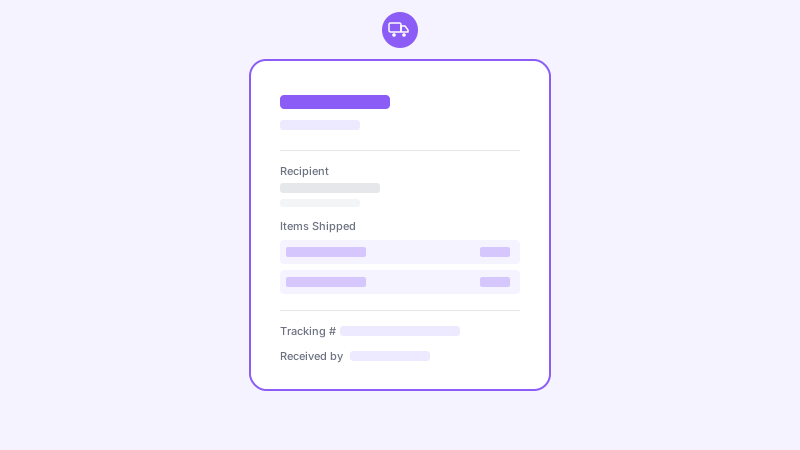
A delivery challan is a transport document that authorises the movement of goods without a sale — it travels with the consignment when no tax invoice exists yet. Under GST in India, Rule 55 of the CGST Rules 2017 lists the exact situations where it replaces the invoice — job work, own-use transfers, goods on approval, exhibitions, liquid gas.
This guide explains the delivery challan meaning, when the document is mandatory, how it differs from a tax invoice and an e-way bill, returnable versus non-returnable movements, and the Section 129 penalty when goods travel without one. Need the document itself rather than the definition? See the delivery challan format guide for Excel, Word and PDF versions, or open the free delivery challan generator.
Delivery challan meaning under GST
So what is a delivery challan, exactly? A delivery challan — also called a delivery slip or dispatch challan — is a document issued when goods are transported from one place to another without an immediate sale. It records what is moving (description, HSN code, quantity, condition), who is sending and receiving it (consignor and consignee with GSTIN), and why. It is proof of goods movement, but it transfers no legal ownership and carries no payment details.
The legal chain is short. Section 31 of the CGST Act 2017 requires a registered supplier to issue a tax invoice for every taxable supply — yet goods often move with no supply happening: a manufacturer's raw materials going to a job worker for processing, a machine off to a workshop for servicing. Rule 55 fills that gap. In plain terms, delivery challan means: these goods are moving for a stated reason, and any sale will be invoiced separately. That is the role of a delivery challan in GST.
The challan accompanies the goods: at a vehicle check it is legal evidence of a legitimate movement, while in your books it is a stock and record-keeping entry, never revenue. Its nearest cousin abroad is the delivery note (see delivery notes explained), which carries no statutory weight.
When is a delivery challan mandatory under GST?
A delivery challan is mandatory whenever a GST-registered business transports goods without a tax invoice: goods sent for job work, stock moved between premises under one GSTIN, goods sent on approval, consignments shipped knocked-down in lots, items taken to an exhibition, and liquid gas where quantity is unknown at removal. Rule 55(1) frames the catch-all as transport for "reasons other than by way of supply", plus other supplies the Board may notify. In short, a delivery challan under GST is valid only in these situations:
| Situation | What it covers | What happens next |
|---|---|---|
| Job work | Inputs, capital goods, moulds, dies or machinery sent by a principal to a job worker, job worker to job worker, or the return to the principal | Goods must come back within the time limits below, or the movement becomes a deemed supply |
| Goods sent on approval | Sale-or-return — a jeweller sending gold necklaces to a retailer for approval, within or outside the state | Tax invoice at acceptance or six months from removal, whichever is earlier (Section 31(7)) |
| Semi or completely knocked down (SKD/CKD), batches or lots | Machinery or plant shipped in parts | Full invoice before the first consignment; each subsequent consignment moves on a challan with a duly certified copy of the invoice; the original travels with the last consignment — Rule 55(5) |
| Exhibition and promotion | Display items, free samples, artwork sent by artists to galleries, trade fairs — even goods exported for exhibition abroad (CBIC Circular 108/27/2019-GST: neither supply nor export, so no LUT or bond) | Goods return after the event or are invoiced when sold |
| Own-use transfer | Branch transfer within one GSTIN — factory to warehouse, warehouse to warehouse, an intrastate stock transfer order (STO) | No GST arises; the goods simply move on the challan |
| Liquid gas | Supply where the quantity leaving the supplier's place of business is unknown at removal | Invoice issued after delivery, once quantity is measured |
| Invoice not issuable at removal | A genuine supply where the tax invoice could not be raised at dispatch | Invoice must follow after delivery — Rule 55(4) |
A correction to a mistake half the internet repeats: moving 500 pairs of shoes from your Delhi warehouse to your Bangalore store is not a challan movement. Registrations in different states are distinct persons under GST, making that inter-branch transfer a Schedule I supply that needs a tax invoice with IGST. Challan-only own-use transfers work within one GSTIN — same-state warehouses or an additional place of business. (Rule 55A: where no e-way bill is required, goods may instead move with a copy of the tax invoice or bill of supply.)
Who issues challans daily? FMCG traders, textiles and apparel warehouses, electronics wholesalers, furniture and home furnishings suppliers, construction firms sending 1,000 bags of cement to a site, service providers moving air conditioners to a workshop, e-commerce returns of defective mobile phones, exhibitors and event organisers, and exporters trucking carpets to Mumbai port.
Mandatory fields on a delivery challan (Rule 55)
Rule 55 prescribes the contents, not the layout — there is no prescribed template, so Excel, Word, a printed delivery challan book or digital software all work if every particular appears:
- Date and number — serially numbered, not exceeding sixteen characters, alphanumeric, in one or multiple series
- Consignor details — name, address and GSTIN (a GSTIN like 27ABCDE1234F1Z5 also tells the officer the state — 27 is Maharashtra)
- Consignee details — name, address and GSTIN or UIN if registered; name, address and place of supply if unregistered
- HSN code and description of goods — a line reads much like an invoice line: steel rods, HSN 7214, 100 tonnes, for job work
- Quantity — provisional, where the exact quantity is not known
- Taxable value
- Tax rate and tax amount — CGST, SGST/UTGST, IGST and cess, only where the movement is itself a supply to the consignee
- Place of supply — for inter-state movement
- Signature of the consignor or authorised signatory
In practice, also add the transporter name, vehicle number, mode of transport and reason for transportation — officers look for them, and e-way bill data must match. A declaration like "this document is not a tax invoice" avoids checkpoint confusion; the format guide shows where each field sits.
Triplicate copies
Rule 55(2) requires the challan in triplicate: the original marked ORIGINAL FOR CONSIGNEE, the duplicate marked DUPLICATE FOR TRANSPORTER, and the triplicate marked TRIPLICATE FOR CONSIGNER. The buyer's acknowledged copy is your delivery confirmation, the transporter's copy answers roadside checks, and the seller's copy anchors the stock record.
Delivery challan vs tax invoice vs e-way bill
The three documents do different jobs: the delivery challan describes goods moving without a sale, the tax invoice is the billing document that records a taxable supply, and the e-way bill is the electronic permit for the journey itself. A challan can never replace an invoice for an actual sales transaction, and neither replaces the e-way bill.
| Delivery challan | Tax invoice | E-way bill | |
|---|---|---|---|
| Purpose | Moves goods without a sale; no payment details | Billing for a supply; states the amount payable and payment terms | Electronic document permitting goods in transit |
| Governing provision | Rule 55, CGST Rules 2017 | Section 31, CGST Act 2017 | Rule 138, CGST Rules 2017 |
| Transfers ownership | No | Yes — with rights and liabilities | No |
| Shows tax | Only where the movement is a supply | Always — GST rate and amount (CGST/SGST or IGST) | Carries document and value references |
| Supports input tax credit | No — a challan cannot support ITC | Yes — the basis of an ITC claim | No |
| E-invoicing / QR code | Not applicable | Applicable above turnover thresholds | Not applicable |
| Needed when | Rule 55 situations | Every taxable supply | Consignment value above ₹50,000 |
The delivery challan and e-way bill are complementary, not substitutes. Rule 55(3) says a movement on a challan in place of an invoice must be declared in the e-way bill under Rule 138, generated on the e-way bill portal from the challan details and transporter ID. Watch the threshold trap: for inter-state job work an e-way bill is required regardless of value. Some businesses print a combined "tax invoice cum delivery challan"; that works only where a supply genuinely exists — compare the contents in our GST invoice format guide. Timing differs too: the challan is issued at dispatch and needs the recipient's acknowledgement; the invoice follows the sale and drives the accounting entries.
Returnable delivery challan vs non-returnable
A returnable delivery challan covers temporary movement — goods expected back after a stated purpose such as job work, repair, testing, an exhibition, or reusable bins and trolleys. A non-returnable challan covers one-way movement, like an own-use transfer or a sales return to the seller. The paperwork is identical; the difference is follow-up: returnable challans stay open in your records until the goods come home.
Three named types cover most daily use: the job work challan (goods out for processing, assembly or repair), the sales return challan (a buyer returning goods for defects or excess supply, with the original invoice reference and reason for return), and the stock transfer challan (movement between your own premises, listing origin and destination). Review open returnable challans monthly — an unreturned item is a pending tax event.
Delivery challan for job work
For job work, the principal issues the delivery challan under Rule 45 read with Rule 55 — for the outward leg, for job-worker-to-job-worker transfers, and for the return leg. It states description, quantity, value and the purpose of work: a textile manufacturer sending 1,000 metres of fabric to a dyeing unit, or a car maker sending metal components to a subcontractor for assembly.
Two clocks start on the original dispatch date. Inputs must return within one year; capital goods within three years (moulds, dies, jigs, fixtures and tools are exempt from the return condition). Miss the deadline and the movement is a deemed supply from the day the goods left — GST payable with interest at 18% per annum under Section 50. Challan details are reported quarterly or half-yearly in Form ITC-04 on the GST portal.
Is a delivery challan legally valid?
Yes. A delivery challan is a legal document under GST — formal evidence in disputes over damaged goods, non-receipt or wrong quantities, and the recognised transport document at inspections. Its value never enters GST reporting; when a sale materialises you raise a tax invoice (the free invoice builder converts the same line items) and reconcile it in GSTR-1 and GSTR-3B.
Retain challans at least six years (72 months) from the end of the relevant financial year, per Section 36. Electronic storage is fine if you can produce a print on demand. A challan can be amended after issue — document the correction. Only GST-registered businesses issue a GST delivery challan; unregistered businesses rely on ordinary transport receipts.
What happens if goods move without a delivery challan?
Goods transported in contravention of the rules — no tax invoice or delivery challan, or no e-way bill where required — face detention or seizure along with the vehicle under Section 129 of the CGST Act. Release requires a penalty of 200% of the tax payable on the goods; for exempted goods, 2% of the value or ₹25,000, whichever is lower. The conveyance is released on the same payment or against security.
Here is what detention orders reaching appellate tribunals actually show: the paperwork usually existed. What triggered Section 129 was a defect — an expired e-way bill, a missing HSN code, a quantity mismatch between challan and vehicle. Treat the challan as a GST compliance document, not a formality: leave no incomplete fields, keep unique numbering, and make the transporter's copy legible.
How to make a delivery challan
- Open the free delivery challan generator — no sign-up.
- Enter consignor and consignee details with GSTIN, serial number, date and purpose (job work, approval, own-use transfer, exhibition).
- Add each item — description, HSN code, provisional quantity if unknown, taxable value — plus transporter name, vehicle number and mode of transport.
- Sign, download as Excel, Word or PDF, print the triplicate set, or share the consignee copy on WhatsApp.
This article is informational only, not tax or legal advice. Primary source: Rule 55, CGST Rules 2017, via the CBIC GST portal — last verified July 2026.
Frequently Asked Questions
What is delivery challan in GST?
Under GST, a delivery challan is the document prescribed by Rule 55 of the CGST Rules 2017 for transporting goods without a tax invoice — used for job work, own-use stock transfers, goods sent on approval, exhibitions, and liquid gas of unknown quantity. It lists the consignor, consignee, HSN codes, quantity and taxable value, travels with the goods in triplicate, and transfers no ownership. Any eventual sale still needs a separate tax invoice.
When is a delivery challan required?
A delivery challan is required whenever goods move without a sale: sending inputs or capital goods for job work, transfers between premises under the same GSTIN, goods sent on approval, knocked-down consignments moving in lots, exhibition and promotion movements, and liquid gas where quantity is unknown at removal. If the movement is a genuine supply but the invoice could not be issued at dispatch, Rule 55(4) lets the invoice follow after delivery.
Is GST charged on a delivery challan?
No. A delivery challan itself creates no GST liability because no supply has taken place — that is the point of the document. The challan shows the tax rate and amount only where the movement is itself a supply to the consignee. When the sale actually happens, you issue a tax invoice with CGST/SGST or IGST, and only that invoice supports input tax credit.
Do I need an e-way bill with a delivery challan?
Yes, when the consignment value exceeds ₹50,000 — Rule 55(3) requires the challan movement to be declared in an e-way bill under Rule 138, generated from the challan details and transporter ID. For inter-state job work, an e-way bill is mandatory regardless of value. The two documents travel together: the challan describes the goods and purpose, the e-way bill permits the journey.
What is a returnable delivery challan?
A returnable delivery challan documents temporary movement where the same goods must come back — job work, repairs, testing, exhibitions, or reusable packaging like bins and trolleys. It stays open in your records until the goods return. For job work, inputs must return within one year and capital goods within three years, otherwise the movement is treated as a supply from the original dispatch date and GST becomes payable with interest.
How long should delivery challans be kept?
Keep delivery challans for at least six years (72 months) from the end of the financial year they relate to, in line with GST record-keeping rules under Section 36 of the CGST Act. Electronic copies are acceptable if you can produce a printout on demand. Detention cases and audits often turn on old transport documents, so a searchable digital archive is worth the effort.
Related Guides & Tools
- Free Delivery Note Generator
- Delivery Note Software
- What Is a Delivery Note? Meaning, Format & Free Template
- Delivery Challan Format in Excel, Word & PDF (Free Download)
- Bill of Lading Template + How to Fill One (Free PDF)
- Packing Slip vs Packing List vs Shipping Label (+Template)
- Vehicle Delivery Note (RTO): Format, PDF & Free Template