What Is a Proforma Invoice? Meaning, Uses & Free Template
By Farasat Abbas Naqvi · Published July 14, 2026 · Updated July 24, 2026

A proforma invoice is a preliminary bill of sale that a seller sends to a buyer before goods ship or work begins — it states exactly what will be supplied, in what quantities, and at what price, but it is not a demand for payment and is never recorded as a sale. Both spellings, proforma and pro forma, are correct; the term is Latin for "as a matter of form", and some accountants call it a preliminary invoice.
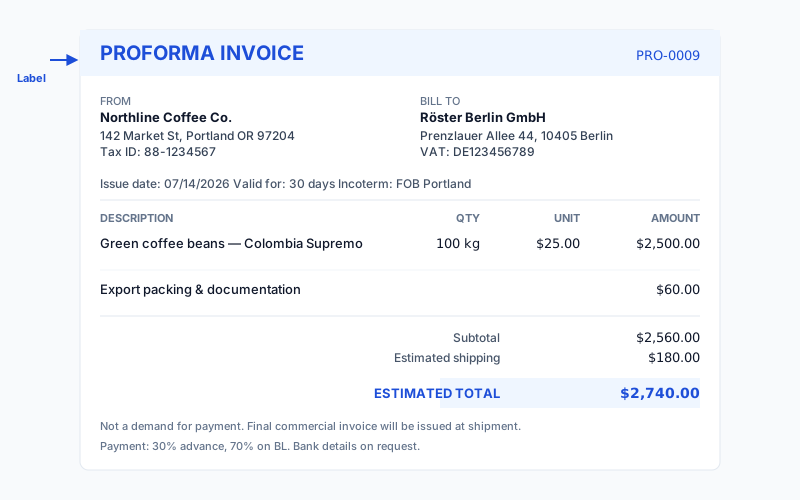
Sellers use one whenever money, approval, or paperwork must move before delivery does: releasing an advance payment, opening a letter of credit, clearing customs, or getting internal sign-off. This guide covers the proforma invoice meaning in plain English, when to use one, what to include, its legal and VAT status, and a free proforma invoice template in Excel, Word, and PDF.
What Is a Proforma Invoice?
A proforma invoice is an estimate dressed as an invoice. It mirrors a commercial invoice line for line — seller and buyer details, itemized goods or services, totals, payment terms — but is clearly labeled "Proforma Invoice" so nobody books it as a real invoice. It signals a firm, good-faith intention to supply at a specified price while both parties stay free to adjust quantities, dates, or scope.
So what does proforma invoice mean in practice? Three things. Commitment: requesting a proforma shows more serious interest than comparing quotations. Flexibility: no sale has occurred, so it can be updated or cancelled at any time. And tax neutrality: issuing one triggers no VAT reporting to HMRC (no tax point) and no entry in accounts receivable — a deal in progress, not a completed transaction.
Proforma Invoice Example
A worked example shows the sequence. Northline Coffee, a US exporter, takes an order from a Hamburg wholesaler for 100 kg of green beans. The buyer's bank wants documentation of the pending sale before opening a letter of credit, so Northline issues proforma PRO-0009:
| Line item | Qty | Unit price | Amount |
|---|---|---|---|
| Green coffee beans, Grade 1 (HS code 0901.11, origin Colombia) | 100 kg | $25.00 | $2,500.00 |
| Sea freight and cargo insurance, CIF Hamburg | 1 | $310.00 | $310.00 |
| Estimated total — prices valid 30 days | $2,810.00 |
The bank confirms the letter of credit, Northline ships, and only then issues commercial invoice INV-2214 — same line items, same $2,810.00 — which is what gets booked to revenue. The proforma never touches the ledgers. A UK proforma invoice example looks identical apart from currency and tax: a Manchester printer confirming a £1,200 branded packaging batch for a retailer shows VAT at 20% (£240) as not yet payable, marked "This is not a VAT invoice".
When to Use a Proforma Invoice
Use a proforma invoice whenever the buyer needs an invoice-shaped document before delivery — to pay, to import, or to get approval. Seven scenarios cover almost every real case:
| Scenario | Why a proforma works | Typical example |
|---|---|---|
| 1. Advance payment or deposit | Gives the buyer a document to pay against before supply, with no premature tax obligation | A wholesaler asks a café for 50% upfront on a coffee bean order |
| 2. Export and customs pre-clearance | Customs assesses duties and taxes from declared values before arrival | US Customs accepts entry on a proforma; commercial invoice follows within 120 days |
| 3. Made-to-order or bespoke goods | Confirms price before production costs are committed — custom work has no resale value if the buyer walks | A clothing manufacturer confirms a 5,000-shirt order before cutting fabric |
| 4. New customers with no credit history | Payment lands before goods leave; credit terms come later | A first-time overseas buyer places a high-value order |
| 5. Buyer's internal approval process | Procurement needs a formal document for budget sign-off and fund release | A B2B buyer raises a purchase order against the proforma |
| 6. Letters of credit and financing | Banks, lenders, and grant bodies want a formal cost breakdown of the pending sale | Financing applications and grant requests |
| 7. Project kickoffs and subscriptions | Locks scope and price in writing before work begins, terms still adjustable | A consultancy confirms a tailored project fee before the start date |
Sellers also issue proformas shortly before shipping when details are undetermined — market-dependent pricing, uncertain quantities, variable shipping charges, or taxes not yet applied. Fixing figures in writing avoids renegotiation after production starts, rushed delivery, and dissatisfied customers. Where procurement is involved, the proforma usually answers a purchase order.
What to Include in a Proforma Invoice
No law dictates the proforma invoice format, so mirror your normal invoice layout and change the label. A complete proforma includes:
- The words "Proforma Invoice" at the top — UK sellers add "This is not a VAT invoice", the marking HMRC expects
- Seller's business name, address, contact details, and logo; buyer's name and billing address
- A proforma reference number and issue date — use a separate PRO- series, not your sequential invoice numbers
- A validity or expiration date stating how long prices hold; material costs and currency rates fluctuate, so 14–30 days is typical
- Itemized descriptions with quantities, unit prices, and subtotals
- For export sales: country of origin, six-digit Harmonized System or Schedule B classification per product, weights and dimensions
- Estimated taxes (VAT or sales tax), shipping costs, discounts, commissions, and fees — shown, but not yet payable
- Delivery terms and shipping details: dispatch method and, for sea freight, ports of loading and discharge
- Proposed payment terms, accepted methods, and timelines, plus any special notes or disclaimers
The US International Trade Administration lists eleven recommended elements for export proformas; the logic is the same — give the buyer and the border everything needed to act. One hard-learned lesson: the most common proforma failure is clerical, not legal. A busy accounts payable team keys the proforma in as a live invoice and pays it — then pays the final invoice too. A separate PRO- series, referenced on the final invoice, kills the duplicate-payment risk and the VAT errors that follow.
Is a Proforma Invoice Legally Binding?
No — a proforma invoice is not legally binding. It is a courtesy document, not a contract: it creates no enforceable payment obligation, the buyer is not required to pay it, and either side can adjust pricing, quantities, scope, or delivery dates before the final invoice. Because no sale has occurred, it cannot be used for accounting purposes either.
The binding documents sit either side of it: upstream, the buyer's purchase order or a signed contract; downstream, the commercial invoice that records the sale. A proforma cannot convert into a commercial invoice — the completed sale gets a new invoice with its own sequential number. An accepted proforma still earns its keep as a reference point for agreed-in-principle terms if a disagreement surfaces; invoice vs purchase order vs quotation shows how the surrounding documents divide the legal work.
Proforma Invoice vs Invoice vs Quotation
The proforma invoice vs invoice question comes down to legal force and timing — and the quotation belongs in the same lineup: an offer, an agreed estimate in invoice form, and a demand for payment.
| Aspect | Quotation | Proforma invoice | Final (commercial) invoice |
|---|---|---|---|
| Stage | Offer: "we can supply X at Y" | Agreed estimate before delivery | Completed sale, payment due |
| Legally binding | No | No | Yes |
| Invoice number | None | Proforma reference only | Unique sequential number |
| Recorded in bookkeeping | No | No | Yes — accounts receivable and payable |
| Supports VAT/GST reclaim | No | No | Yes, as a valid tax invoice |
| Buyer's mindset | Comparing options | Committed; needs paperwork to pay or import | Has received the goods or service |
The usual sequence runs quotation → proforma → purchase order → delivery → invoice, though small deals skip steps. A proforma is a step beyond a regular quotation: the customer has committed to the pricing, and the seller has confirmed the final cost while leaving room for change — the invoice vs quotation guide covers that front end.
Proforma Invoice vs Commercial Invoice
In international trade the proforma invoice vs commercial invoice split is about which document travels when. The proforma goes ahead of the shipment — buyers use it to obtain import licenses and permits, arrange credit and currency transfers, and pre-clear goods. The commercial invoice travels with the shipment as the non-negotiable legal record of sale, relied on by customs for final duty calculation and by freight forwarders, brokers, insurance companies, and banks alongside the bill of lading. Full field-by-field breakdown: proforma invoice vs commercial invoice.
Not a tax invoice: VAT, GST and the tax point
A proforma invoice is not a tax invoice in any jurisdiction — the buyer cannot reclaim input VAT or GST from it. UK rules are specific. Issuing a proforma creates no tax point, so a VAT-registered business can send one to an unknown new customer without owing HMRC anything. The moment the customer pays, though, an actual tax point exists — the label does not change that — and a valid VAT invoice covering the prepayment is due within 30 days, showing your VAT registration number, the VAT rate and amount, and totals excluding and including VAT. (The basic tax point otherwise falls at delivery, shifting if a VAT invoice follows within 14 days.) The classic compliance error: send a proforma, receive payment, assume the documentation is complete. HMRC's VAT guide (Notice 700), sections 16–17, sets out the requirements. US businesses face no VAT, but the same logic holds — no revenue recognition and no sales tax event until the real invoice exists.
Proforma Invoice for Advance Payment
Using a proforma invoice for advance payment is the document's most common job outside export trade. The flow takes five steps:
- Send the proforma with payment details and a validity date.
- The buyer approves it internally and pays the deposit — or 100% upfront.
- UK sellers: payment creates the tax point, so issue a VAT invoice for the amount received within 30 days.
- Deliver the goods or perform the service.
- Issue the final invoice, referencing the proforma number and any amount already paid.
The cash-flow case is blunt. Late payments cost the UK economy an estimated £11 billion a year, roughly 90% of UK firms reported payment delays last year, and the average overdue invoice runs 32 days behind. Part-payment against a proforma beats chasing the full amount after delivery — and beats bridging the gap with invoice finance or an overdraft. Freelancers, agencies, and consultancies use the same pattern to confirm scope and take deposits; in B2B ecommerce, many buyers cannot release payment until a proforma enters their purchase-order workflow. An accepted proforma also sharpens revenue visibility and cash-flow forecasting, which feeds stock management and labour scheduling. When the job is done, generate the matching final invoice with the free invoice generator — no signup needed.
Proforma Invoice for Shipping and Customs
Carriers ask for a proforma invoice when the shipper cannot yet produce a commercial one — typically samples, gifts, warranty replacements, or made-to-order goods. FedEx, DHL, and UPS each publish downloadable, fillable proforma invoice PDFs, and the declared values flow into the export declaration. US Customs and Border Protection accepts entry on a proforma carrying enough information to determine admissibility, classification, and duties due, with the commercial invoice produced within 120 days. For customs clearance in the UK, the stakes rose after Brexit: goods moving between Great Britain and the EU need customs declarations in both directions, UK Border Force works from declared values, and a missing or inaccurate proforma reliably strands shipments at the border. Keep descriptions and HS codes transferable to the commercial invoice so the documents match, and pack a delivery note so the receiver can check goods against what was declared.
Free Proforma Invoice Template (Excel, Word and PDF)
Download the free proforma invoice template in the format you work in — each file carries the "Proforma Invoice" label, a validity date field, and an itemized table with taxes shown but not payable:
- Excel version (.xlsx) — auto-calculating totals; the spreadsheet format buyers and freight forwarders expect for export
- Word version (.docx) — an editable format for adding logos, disclaimers, and custom terms
- PDF version — print-ready and safe to email anywhere
Prefer not to fight formatting? The proforma invoice generator produces a branded, correctly labeled document in about two minutes, and the proforma invoice Excel builder does the same in spreadsheet form. If the deal starts as a price offer, build it in the quotation generator first, then convert the accepted quote. Whichever route you take, attach supporting documents, follow up before the validity date lapses, and keep a copy of every version — the final invoice should not stray far from the proforma the buyer approved.
Frequently Asked Questions
What is a proforma invoice?
A proforma invoice is a preliminary bill of sale a seller sends to a buyer before goods are shipped or services performed. It states what will be supplied and at what price, but it is not a demand for payment, is not legally binding, and is never recorded as a sale. Both spellings — proforma and pro forma — mean the same thing.
Is a proforma invoice an invoice?
No. Despite the name and identical layout, a proforma has no fiscal value: it carries no sequential invoice number, creates no payment obligation, and cannot support a VAT or GST claim. A full invoice must still be issued before the sale is recorded and payment formally requested.
Can you pay against a proforma invoice?
Yes — advance payment is the document's main everyday use. Buyers routinely pay deposits or full amounts against a proforma in export and made-to-order sales. The seller must then follow up with the real invoice; in the UK, payment creates a tax point and a VAT invoice is due within 30 days.
Is a proforma invoice a tax invoice?
No. A proforma cannot be used to reclaim input VAT or GST, and HMRC expects UK proformas to be marked "This is not a VAT invoice". Only the VAT or tax invoice issued at the tax point supports an input tax reclaim.
Can a proforma invoice be cancelled or changed?
Yes — at any time and without a credit note, because it has no legal status. If the buyer changes the order, the seller simply issues an updated version. Once the final invoice exists, corrections need a credit note instead.
When does the seller issue a proforma invoice?
Usually after a quote is accepted but before delivery — and whenever the buyer requests one for customs, a letter of credit, financing, or internal approval. It suits moments when quantities, market pricing, taxes, or shipping charges are not yet final.
This guide is general information, not tax or legal advice. UK VAT treatment summarised from HMRC's VAT guide (Notice 700), last verified July 2026 — confirm current rules with HMRC or your accountant.
Frequently Asked Questions
What is a proforma invoice?
A proforma invoice is a preliminary bill of sale a seller sends to a buyer before goods are shipped or services performed. It states what will be supplied and at what price, but it is not a demand for payment, is not legally binding, and is never recorded as a sale. Both spellings — proforma and pro forma — mean the same thing.
Is a proforma invoice an invoice?
No. Despite the name and identical layout, a proforma has no fiscal value: it carries no sequential invoice number, creates no payment obligation, and cannot support a VAT or GST claim. A full invoice must still be issued before the sale is recorded and payment formally requested.
Can you pay against a proforma invoice?
Yes — advance payment is the document's main everyday use. Buyers routinely pay deposits or full amounts against a proforma in export and made-to-order sales. The seller must then follow up with the real invoice; in the UK, payment creates a tax point and a VAT invoice is due within 30 days.
Is a proforma invoice a tax invoice?
No. A proforma cannot be used to reclaim input VAT or GST, and HMRC expects UK proformas to be marked "This is not a VAT invoice". Only the VAT or tax invoice issued at the tax point supports an input tax reclaim.
Can a proforma invoice be cancelled or changed?
Yes — at any time and without a credit note, because it has no legal status. If the buyer changes the order, the seller simply issues an updated version. Once the final invoice exists, corrections need a credit note instead.
When does the seller issue a proforma invoice?
Usually after a quote is accepted but before delivery — and whenever the buyer requests one for customs, a letter of credit, financing, or internal approval. It suits moments when quantities, market pricing, taxes, or shipping charges are not yet final.