VAT, GST, and Sales Tax: A Global Guide for Businesses
By Farasat Abbas Naqvi · Published March 18, 2026
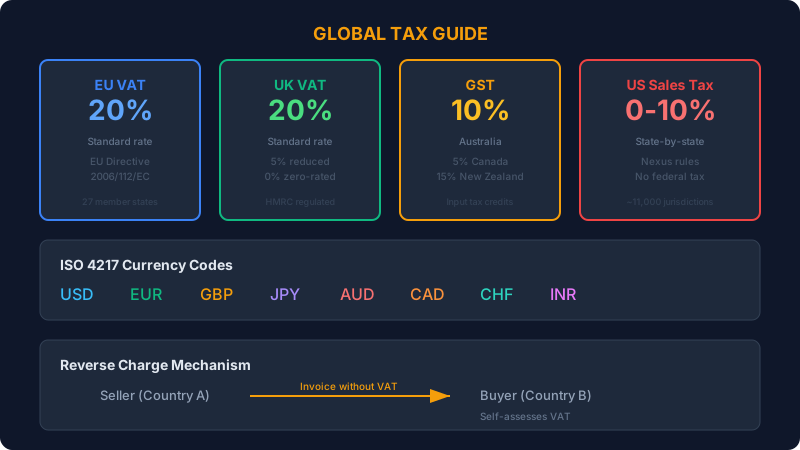
If you sell goods or services across borders — or even domestically — understanding indirect taxes is essential. VAT (Value Added Tax), GST (Goods and Services Tax), and sales tax are the three main systems used worldwide. Over 170 countries levy some form of consumption tax, and getting it wrong can result in penalties, double taxation, or lost revenue.
What Is VAT (Value Added Tax)?
VAT is a multi-stage tax collected at each point of the supply chain where value is added. The business charges VAT on sales (output tax) and reclaims VAT paid on purchases (input tax). Only the net difference is remitted to the tax authority.
The EU VAT system is governed by Council Directive 2006/112/EC, with detailed guidance available from the European Commission's VAT portal, which sets minimum rates and rules for all 27 EU member states:
- Standard rate — Must be at least 15% (ranges from 17% in Luxembourg to 27% in Hungary)
- Reduced rates — One or two reduced rates of at least 5% for essential goods
- Zero rate — Applied to exports and certain essential items in some countries
- Exempt supplies — Financial services, education, and healthcare in many jurisdictions
What Is GST (Goods and Services Tax)?
GST is functionally similar to VAT but is often structured as a single-rate, destination-based tax. Key implementations include:
- Australia — 10% GST on most goods and services (administered by the ATO)
- Canada — 5% federal GST, plus provincial sales taxes (PST) or harmonized sales tax (HST) in some provinces
- New Zealand — 15% GST, one of the broadest-based systems globally
- India — Multi-tier GST (5%, 12%, 18%, 28%) introduced in 2017, replacing multiple indirect taxes
- Singapore — 9% GST (increased from 8% in 2024)
US Sales Tax: A Unique System
Unlike VAT/GST, US sales tax is a single-stage tax collected only at the final point of sale. There is no federal sales tax — rates are set by states, counties, and cities, creating approximately 11,000+ tax jurisdictions.
After the landmark South Dakota v. Wayfair (2018) Supreme Court decision, states can require out-of-state sellers to collect sales tax if they meet economic nexus thresholds (typically $100,000 in sales or 200 transactions).
The Reverse Charge Mechanism
The reverse charge is a critical concept for cross-border B2B transactions within the EU and other jurisdictions. Under this mechanism:
- The seller issues an invoice without VAT
- The buyer self-assesses the VAT and reports it as both output and input tax
- The net effect for the buyer is typically zero (if they can reclaim input VAT)
- This prevents the need for foreign businesses to register for VAT in every country they sell to
When creating invoices for reverse charge transactions in ProeInvoice, set the tax rate to 0% and include a note stating: "Reverse charge: VAT to be accounted for by the recipient as per Article 196 of Directive 2006/112/EC."
ISO 4217: International Currency Standards
When invoicing internationally, it's essential to use standardized currency codes as defined by ISO 4217. This standard, maintained by the International Organization for Standardization, ensures clarity in financial transactions:
- USD — United States Dollar
- EUR — Euro
- GBP — British Pound Sterling
- JPY — Japanese Yen
- AUD — Australian Dollar
- CAD — Canadian Dollar
- CHF — Swiss Franc
- INR — Indian Rupee
ProeInvoice supports all major ISO 4217 currency codes, allowing you to create invoices in your client's preferred currency.
Tax Compliance Checklist for International Invoicing
- Include your tax registration number (VAT ID, GST number, or equivalent)
- Display the tax rate and amount separately from the net price
- Use the correct ISO 4217 currency code
- Apply the correct tax type — inclusive (tax included in price) or exclusive (tax added on top)
- Note any exemptions or reverse charges with the legal basis
- Maintain records for the statutory retention period (typically 5–10 years depending on jurisdiction)
- Issue invoices within the legally required timeframe (varies by country)
Setting Up Tax in ProeInvoice
ProeInvoice makes international tax compliance simple. You can configure tax per invoice or set defaults in your settings:
- Choose between inclusive, exclusive, or per-item tax calculation
- Set custom tax labels (VAT, GST, Sales Tax, IVA, MwSt, etc.)
- Apply different tax rates to individual line items
- Include your tax registration number on every invoice
Need to create tax-compliant invoices for international clients? Try ProeInvoice's free invoice builder with built-in tax support for businesses worldwide.