Understanding Accounts Receivable: A Complete Business Guide
By Farasat Abbas Naqvi · Published April 1, 2026
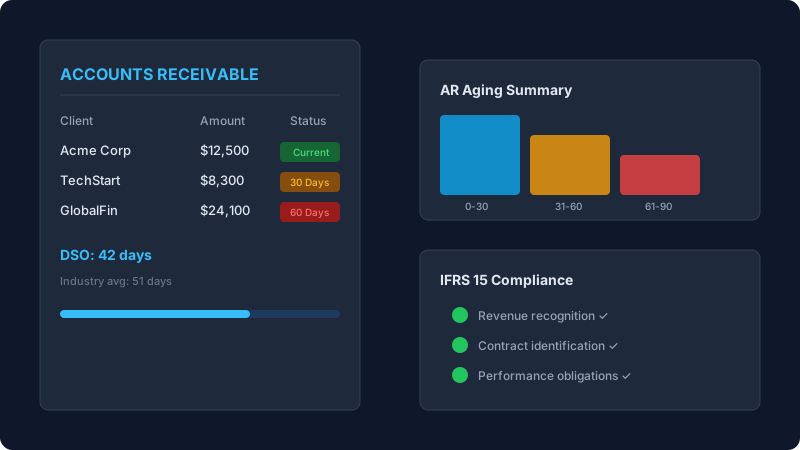
Accounts receivable (AR) is the lifeblood of business cash flow. It represents the money owed to your company by customers for goods or services delivered but not yet paid for. Effective AR management is critical for maintaining healthy liquidity, minimizing bad debt, and ensuring long-term financial stability.
What Is Accounts Receivable?
In accounting terms, accounts receivable is classified as a current asset on the balance sheet. Under both IFRS (International Financial Reporting Standards) and US GAAP (Generally Accepted Accounting Principles), AR is recorded when revenue is recognized — typically when a performance obligation is satisfied, as defined by IFRS 15: Revenue from Contracts with Customers.
When you issue an invoice through ProeInvoice, you're essentially creating an accounts receivable entry. The invoice amount becomes a legal claim against your customer until payment is received.
The AR Lifecycle: From Invoice to Cash
Understanding the full lifecycle helps you manage receivables more effectively:
- Invoice creation — Generate and send a professional invoice immediately after delivering goods or services
- Credit period — The agreed payment window (e.g., Net 30, Net 60) during which the customer is expected to pay
- Collection — Follow-up activities including reminders, statements, and escalation procedures
- Cash application — Matching received payments to outstanding invoices and updating records
- Write-off or provision — Recognizing uncollectible amounts as bad debt expense
Aging Reports: Your AR Health Check
An accounts receivable aging report categorizes outstanding invoices by the length of time they've been unpaid. This is one of the most important tools in financial management, recommended by the AICPA (American Institute of Certified Public Accountants) and required under most audit frameworks.
Standard aging buckets include:
- Current (0–30 days) — Invoices within normal payment terms
- 31–60 days — Slightly overdue; requires a reminder
- 61–90 days — Significantly overdue; escalate collection efforts
- 90+ days — High risk of non-payment; consider provisioning for bad debt
Under IFRS 9: Financial Instruments, businesses must apply an Expected Credit Loss (ECL) model as specified by IFRS 9: Financial Instruments, which requires estimating potential losses on receivables at the time they are recognized — not just when they become overdue.
Days Sales Outstanding (DSO): The Key Metric
DSO measures the average number of days it takes to collect payment after a sale. It's calculated as:
DSO = (Accounts Receivable ÷ Total Credit Sales) × Number of Days
According to the Credit Research Foundation, the average DSO across industries is approximately 40–50 days. A lower DSO indicates faster collection, which directly improves cash flow.
- Below 30 days — Excellent; strong collection processes
- 30–45 days — Good; typical for well-managed businesses
- 45–60 days — Needs attention; review credit policies
- Above 60 days — Critical; significant cash flow risk
IFRS 15: Revenue Recognition and AR
IFRS 15, effective since January 2018, establishes a five-step model for recognizing revenue from contracts with customers. This standard directly affects when and how AR is recorded:
- Step 1: Identify the contract with the customer
- Step 2: Identify the performance obligations
- Step 3: Determine the transaction price
- Step 4: Allocate the transaction price to performance obligations
- Step 5: Recognize revenue when (or as) performance obligations are satisfied
For invoicing purposes, this means you should only create an invoice — and record the receivable — when you've fulfilled your obligation to the customer. ProeInvoice helps you track this by linking invoices to specific deliverables and milestones.
Bad Debt Provisioning
Not all receivables will be collected. Under IAS 36: Impairment of Assets and IFRS 9, businesses must estimate and provision for expected losses. Common methods include:
- Percentage of sales method — Estimate bad debt as a fixed percentage of total credit sales
- Aging method — Apply increasing loss percentages to older aging buckets
- Specific identification — Review individual accounts and assess collectibility
Best Practices for AR Management
- Invoice promptly — send invoices within 24 hours of delivery
- Establish clear credit policies before extending payment terms
- Automate payment reminders and follow-up sequences
- Offer multiple payment methods to reduce friction
- Review your aging report weekly and act on overdue accounts
- Consider early payment discounts (e.g., 2/10 Net 30) for large invoices
- Use invoice tracking to monitor when clients view your invoices
Ready to improve your accounts receivable management? Create professional invoices with ProeInvoice and get paid faster with clear terms, automated tracking, and multiple payment options.