Financial Statements Explained: Balance Sheet, Income Statement & Cash Flow
By Farasat Abbas Naqvi · Published March 12, 2026
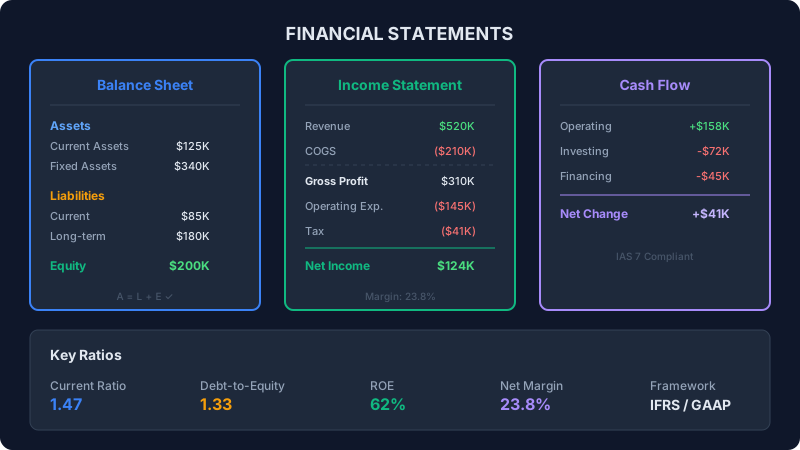
Financial statements are the language of business. They tell the story of a company's financial health, performance, and cash position. Under IAS 1: Presentation of Financial Statements, every entity preparing IFRS-compliant financial reports must produce a complete set of financial statements at least annually. A business owner reviewing their own numbers and an investor sizing up an opportunity read the very same statements — so understanding these documents is essential.
The Three Core Financial Statements
Both IFRS and US GAAP require three primary financial statements, plus a statement of changes in equity and accompanying notes:
1. The Balance Sheet (Statement of Financial Position)
The balance sheet provides a snapshot of a company's financial position at a specific point in time. Under IAS 1, it must present:
- Assets — Resources owned by the business, classified as current (convertible to cash within 12 months) or non-current
- Liabilities — Obligations owed to others, also classified as current or non-current
- Equity — The residual interest after deducting liabilities from assets (owner's claim)
The fundamental equation: Assets = Liabilities + Equity. This must always balance — hence the name "balance sheet." Under IFRS, assets and liabilities are presented in order of liquidity, while US GAAP typically lists them from most to least liquid.
2. The Income Statement (Statement of Profit or Loss)
The income statement shows a company's financial performance over a period (month, quarter, or year). Key components include:
- Revenue — Income from core business activities, recognized per IFRS 15 or ASC 606
- Cost of Goods Sold (COGS) — Direct costs of producing goods or services
- Gross Profit — Revenue minus COGS
- Operating Expenses — Overhead costs including salaries, rent, marketing, and depreciation
- Operating Income (EBIT) — Gross profit minus operating expenses
- Interest and Tax — Financing costs and income tax expense
- Net Income — The bottom line; total profit after all expenses and taxes
IAS 1 allows two formats: classifying expenses by nature (materials, employee costs, depreciation) or by function (COGS, selling expenses, admin expenses). Most businesses use the functional format.
3. The Cash Flow Statement
Governed by IAS 7, the cash flow statement shows actual cash movements during a period, divided into:
- Operating activities — Cash from day-to-day business operations
- Investing activities — Cash spent on or received from long-term assets
- Financing activities — Cash from debt, equity, and dividend transactions
This statement reconciles the difference between net income (accrual-based) and actual cash position. A company can be profitable yet cash-poor — the cash flow statement reveals this.
Financial Ratio Analysis
Financial ratios derived from these statements help assess business health. Key ratios recognized by the CFA Institute and standard financial analysis frameworks include:
Liquidity Ratios
- Current Ratio = Current Assets ÷ Current Liabilities (healthy: above 1.5)
- Quick Ratio = (Current Assets − Inventory) ÷ Current Liabilities (more conservative)
Profitability Ratios
- Gross Margin = Gross Profit ÷ Revenue
- Net Margin = Net Income ÷ Revenue
- Return on Equity (ROE) = Net Income ÷ Shareholders' Equity
Efficiency Ratios
- Days Sales Outstanding (DSO) = (AR ÷ Revenue) × 365
- Asset Turnover = Revenue ÷ Total Assets
Leverage Ratios
- Debt-to-Equity = Total Liabilities ÷ Shareholders' Equity
- Interest Coverage = EBIT ÷ Interest Expense
XBRL: Digital Financial Reporting
XBRL (eXtensible Business Reporting Language) is the global standard for digital financial reporting, mandated by the SEC in the United States, ESMA in Europe, and regulators in over 60 countries. XBRL tags each financial data point with a machine-readable identifier, enabling automated analysis, comparison, and validation.
For small businesses, understanding XBRL matters because:
- Regulatory filings increasingly require XBRL format
- Banks and investors use XBRL data for credit decisions
- It enables automated benchmarking against industry peers
Audit Readiness
Well-prepared financial statements make audits smoother and less costly. Under ISA 200 (International Standards on Auditing), auditors assess whether financial statements are free from material misstatement. To be audit-ready:
- Maintain organized, complete records with supporting documentation
- Reconcile all bank accounts monthly
- Keep a clear audit trail for every transaction
- Ensure consistent application of accounting policies
- Prepare schedules for receivables, payables, and fixed assets
How Invoicing Feeds Financial Statements
Every invoice you create directly impacts your financial statements: it creates revenue on the income statement, an accounts receivable asset on the balance sheet, and eventually a cash inflow on the cash flow statement. Accurate, timely invoicing with ProeInvoice ensures your financial statements tell the true story of your business.
Start building a solid financial foundation. Sign up for ProeInvoice free and create professional invoices that keep your books accurate and audit-ready.