Double-Entry Bookkeeping Explained: The Foundation of Modern Accounting
By Farasat Abbas Naqvi · Published March 28, 2026
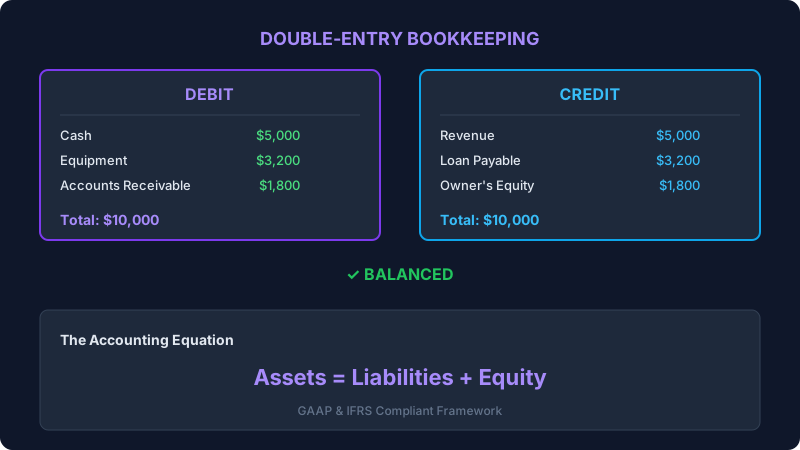
Double-entry bookkeeping is the universal language of accounting. Developed in the 15th century by Luca Pacioli — often called the "Father of Accounting" — this system remains the foundation of every modern financial reporting framework, including IFRS and US GAAP. From a freelancer tracking expenses to a CFO managing a multinational, the same mechanics apply — which is exactly why understanding double-entry bookkeeping is essential.
The Core Principle: Every Transaction Has Two Sides
The fundamental rule of double-entry bookkeeping is simple: every financial transaction affects at least two accounts. For every debit entry, there must be a corresponding credit entry of equal value. This ensures that the books always balance and provides a built-in error-detection mechanism.
The Accounting Equation
Double-entry bookkeeping is built on the accounting equation, recognized by both IASB (International Accounting Standards Board) and FASB (Financial Accounting Standards Board):
Assets = Liabilities + Owner's Equity
Every transaction must maintain this equation's balance. If you purchase equipment (increasing assets) with a bank loan (increasing liabilities), both sides of the equation increase equally.
Understanding Debits and Credits
Debits and credits are the building blocks of every journal entry. Their effect depends on the account type:
- Assets — Debits increase, credits decrease (e.g., cash, equipment, accounts receivable)
- Liabilities — Credits increase, debits decrease (e.g., loans, accounts payable)
- Equity — Credits increase, debits decrease (e.g., owner's capital, retained earnings)
- Revenue — Credits increase, debits decrease (e.g., sales, service income)
- Expenses — Debits increase, credits decrease (e.g., rent, salaries, utilities)
The Chart of Accounts
A chart of accounts (COA) is the organized list of all accounts used by a business. Under IAS 1: Presentation of Financial Statements, accounts should be structured to facilitate clear financial reporting. A typical COA includes:
- 1000–1999: Assets (current and non-current)
- 2000–2999: Liabilities (current and long-term)
- 3000–3999: Equity accounts
- 4000–4999: Revenue accounts
- 5000–9999: Expense accounts
Journal Entries: Recording Transactions
Every business transaction is recorded as a journal entry in the general ledger. Here's an example of recording a $5,000 invoice payment received from a client:
- Debit: Cash (Asset) — $5,000 (cash increases)
- Credit: Accounts Receivable (Asset) — $5,000 (receivable decreases)
And when you originally issued the invoice:
- Debit: Accounts Receivable — $5,000
- Credit: Revenue — $5,000
The Trial Balance
A trial balance is a report that lists all accounts and their balances at a specific date. Under proper double-entry bookkeeping, total debits must equal total credits. If they don't, there's an error that must be found and corrected before financial statements can be prepared.
The trial balance serves as a checkpoint before creating the three core financial statements required by IAS 1: the balance sheet, income statement, and cash flow statement.
GAAP and IFRS Compliance
Both major accounting frameworks mandate double-entry bookkeeping:
- US GAAP — Governed by the FASB, requires accrual-based double-entry accounting for all publicly traded companies
- IFRS — Used in over 140 countries, mandated by the IASB, built entirely on double-entry principles
- Accrual basis — Both frameworks require recording transactions when they occur, not when cash changes hands (as per IAS 1 and ASC 606)
Common Mistakes to Avoid
- Unbalanced entries — Always verify debits equal credits before posting
- Wrong account classification — Ensure expenses aren't recorded as assets, and vice versa
- Missing entries — Record every transaction, no matter how small
- Mixing personal and business — Maintain separate accounts as required by accounting standards
- Ignoring the trial balance — Run it monthly to catch errors early
How Invoicing Connects to Bookkeeping
Every invoice you create in ProeInvoice represents a bookkeeping transaction. When you issue an invoice, it creates an accounts receivable entry (debit) and a revenue entry (credit). When the client pays, cash increases (debit) and accounts receivable decreases (credit). Understanding this connection helps you maintain accurate books and prepare for tax season. For a deeper dive, see Investopedia's guide to double-entry bookkeeping.
Start creating invoices that integrate seamlessly with your accounting workflow. Sign up for ProeInvoice free and keep your books balanced.