How to Manage Cash Flow for Small Businesses: Expert Strategies
By Farasat Abbas Naqvi · Published March 22, 2026
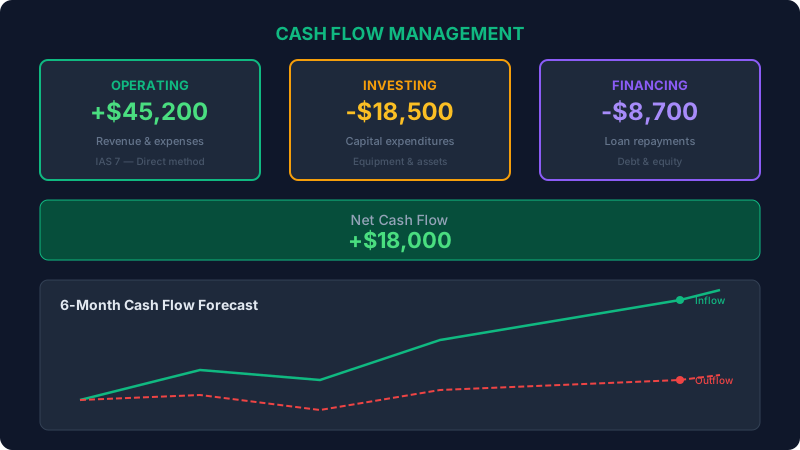
Cash flow is the single most important factor in small business survival. According to a U.S. Bank study, 82% of small businesses that fail cite cash flow problems as a primary cause. Yet cash flow management is often misunderstood — profitability and cash flow are not the same thing. A profitable business can still run out of cash if receivables aren't collected on time or expenses are poorly timed.
Cash Flow vs. Profit: Understanding the Difference
Profit is an accounting concept measured over a period. Cash flow is the actual movement of money in and out of your business. Under accrual accounting (required by both IFRS and GAAP), revenue is recorded when earned — not when cash is received. This creates a timing gap that can be dangerous for small businesses.
For example, you might record $50,000 in revenue this month (profitable!), but if clients are on Net 60 payment terms, you won't see that cash for two months. Meanwhile, rent, salaries, and suppliers need to be paid now.
The Cash Flow Statement: IAS 7
IAS 7: Statement of Cash Flows is the international standard governing how cash flow is reported. It requires businesses to classify cash flows into three categories:
Operating Activities
Cash generated from core business operations — the most important section for small businesses. It includes:
- Cash received from customers
- Cash paid to suppliers and employees
- Interest and tax payments
- Other operating receipts and payments
IAS 7 permits two methods of presentation: the direct method (showing actual cash receipts and payments) and the indirect method (adjusting net income for non-cash items). The IASB encourages the direct method for its clarity.
Investing Activities
Cash spent on or received from long-term assets:
- Purchase or sale of equipment and property
- Investment in securities or other businesses
- Loans made to other entities
Financing Activities
Cash flows related to funding the business:
- Proceeds from issuing shares or taking loans
- Repayment of borrowings
- Dividend payments
Cash Flow Forecasting: Planning Ahead
A cash flow forecast projects your future cash position based on expected inflows and outflows. The SBA and the OECD (Organisation for Economic Co-operation and Development) recommend that small businesses maintain rolling 13-week cash flow forecasts for short-term liquidity management.
Key steps in creating a forecast:
- Project revenue — Based on confirmed orders, historical patterns, and seasonal trends
- Estimate collection timing — Factor in your actual DSO, not just payment terms
- List fixed expenses — Rent, salaries, insurance, subscriptions
- Include variable costs — Materials, shipping, commissions
- Account for one-time items — Tax payments, equipment purchases, loan repayments
- Calculate net cash flow — Inflows minus outflows for each period
- Track cumulative balance — Identify when cash might run low
Working Capital Optimization
Working capital — the difference between current assets and current liabilities — determines your ability to meet short-term obligations. The IAS 1 framework requires businesses to disclose current vs. non-current classifications on the balance sheet.
Strategies to optimize working capital:
- Accelerate receivables — Offer early payment discounts, use electronic invoicing, and follow up promptly
- Negotiate payable terms — Extend supplier payment terms where possible
- Manage inventory — Reduce excess stock to free up cash
- Use invoice financing — Convert outstanding invoices into immediate cash
The Cash Conversion Cycle (CCC)
The CCC measures how long it takes to convert investments in inventory and resources into cash from sales. It's calculated as:
CCC = Days Inventory Outstanding + Days Sales Outstanding − Days Payable Outstanding
A shorter CCC means faster cash generation. According to Deloitte's Working Capital Report, top-performing companies maintain a CCC 30–40% shorter than industry averages.
Emergency Cash Flow Strategies
- Negotiate extended terms with your largest suppliers
- Offer clients a 2–5% discount for immediate payment
- Review and cut non-essential subscriptions and expenses
- Consider a business line of credit before you need it
- Invoice partial amounts upfront for large projects (progress billing)
- Lease equipment instead of purchasing to preserve cash
Better invoicing means better cash flow. Create and send professional invoices with ProeInvoice to set clear payment terms, track outstanding amounts, and get paid faster.